
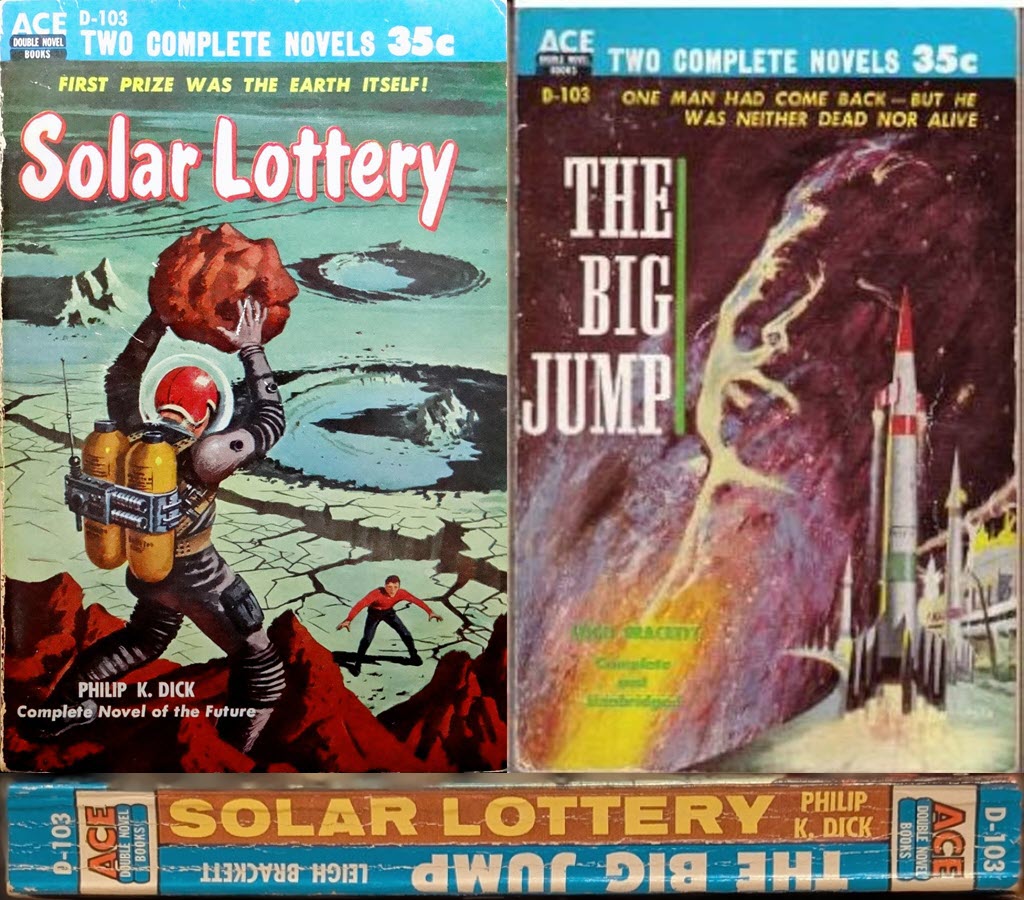
Philip K Dick’s first published novel was Solar Lottery in 1955. It was a thirty five cent Ace paperback.
If you flip the book over, there’s no back cover, there’s a different front cover, and it’s upside down. When you turn it right side up, it’s a novel by Leigh Brackett, The Big Jump.
Solar Lottery and The Big Jump - two science fiction novels, two front covers, two title pages, one spine. There’s a story to be told about that, and it happens to feature legendary publisher Donald Wollheim. Remember Wollheim? He’s the one who published the unauthorized paperback edition of The Lord Of The Rings in 1965 and launched it into global popularity.
Let’s take a trip back in time to the era of Ace Doubles.
1930s/1940s - The pulps
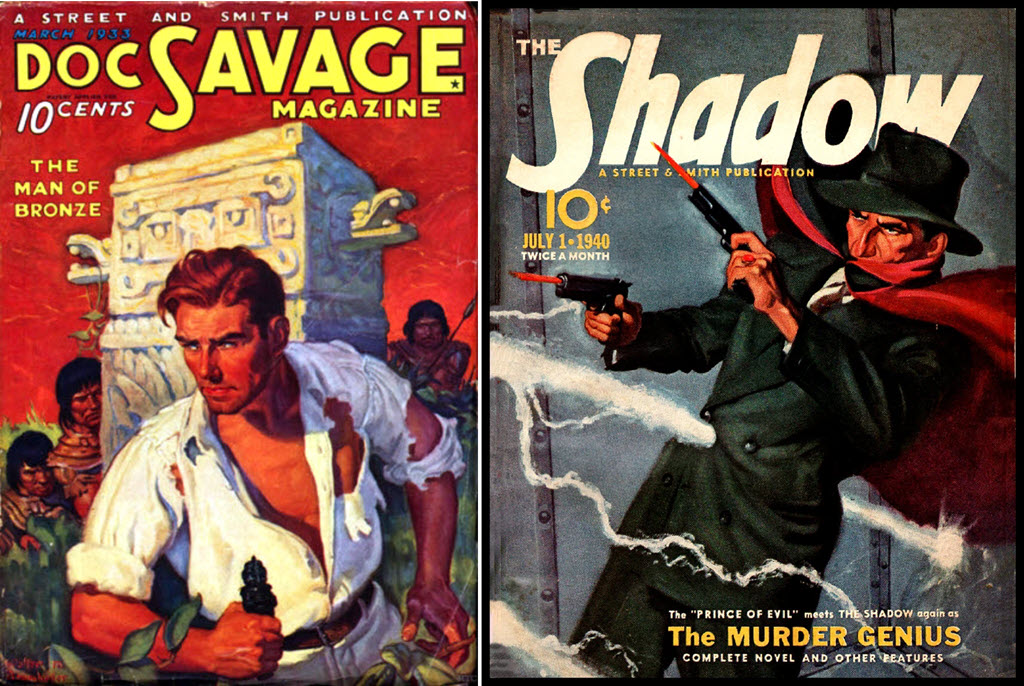
Between the two world wars, the predominant form of entertainment in the United States was pulp magazines - cheap, mass-produced fiction printed on low quality paper. At a dime a copy, a pulp magazine was affordable escapism during the Great Depression. There were literally hundreds of them on newsstands in the mid-1930s. Short sentences, frequent cliffhangers, sensationalism, exotic locations, black and white morality, stock characters - square-jawed hero, femme fatale, mad scientist, damsel in distress.
The pulps of the 1940s launched the Golden Age of Science Fiction. Pulp SF thrived in Astounding Science Fiction, Amazing Stories, Planet Stories, Thrilling Wonder Stories, and many more monthlies. Titans of SF started their careers in the pulps - Robert Heinlein, Isaac Asimov, Theodore Sturgeon, Ray Bradbury, and many more. Philip Dick kept himself barely out of poverty by churning out more than 60 stories in pulp magazines in 1953 and 1954 alone.
Side note: my pulp period came in the 1960s when Bantam reprinted the Doc Savage stories that had first appeared in 1930s and 40s pulps. Like many of the pulp series, the author’s name - “Kenneth Robeson” - was a pseudonym for a rotating cast of authors who churned out stories as fast as they could type. Lester Dent, one of the primary Doc Savage authors, consistently produced 200,000 words per month for the pulps. The stories were absurd and thrilling and the writing is indefensible and I adore them to this day. I have all 181 (181!) Doc Savage novels in more recent reprint editions on the shelves. Obsessive and yet somehow shallow, that’s me, yup.
1940s/1950s - Paperbacks
The American paperback industry was launched in 1939 when Pocket Books began selling books for a quarter in the same places that pulp magazines were sold - wire spinner racks in drugstores, candy shops, newsstands, and train stations.
Millions of free paperbacks were shipped to soldiers overseas in World War II, creating a generation of men who wanted to read disposable novels. The first paperbacks had lurid covers to match the pulps.
They sold like gangbusters. Pulp magazines collapsed in the 1950s, pushed out by television on one side and more durable paperbacks on the other.
The stage was set for Donald Wollheim to build an empire on the flip of a book.
1950s - Ace Doubles
Donald Wollheim was a seasoned veteran of the publishing trenches, a man of extreme opinions and direct action. He started publishing Ace Doubles in 1952 - two novels bound together in a way that gave equal billing to both, doubling the visual impact on the drugstore spinner and priced at thirty five cents, thus creating the perception of a bargain.
The odd format transformed the economics of publishing, launched the careers of many authors, and defined a generation of genre fiction.
Pulp novellas were typically limited to 30,000 words. Standalone novels were at least 60,000 words; authors accustomed to writing for pulps struggled to produce full-length novels. But they were comfortable in the Ace Double world - a novel in the Ace Doubles line was required to be 35,000 to 50,000 words to avoid causing the binding to fail. This forced a specific style of writing - breakneck pacing, plot-driven, punchy, prizing quantity over quality.
For the first year the Ace Doubles focused on mysteries and westerns, including a western by Louis L’Amour under a pseudonym. Authors used pseudonyms frequently for the Ace Doubles: to hide their identity if they were also trying to build a reputation for higher quality books; to publish multiple books in a single month; or to adopt a house name owned by the publisher, the literary equivalent of an assembly line.
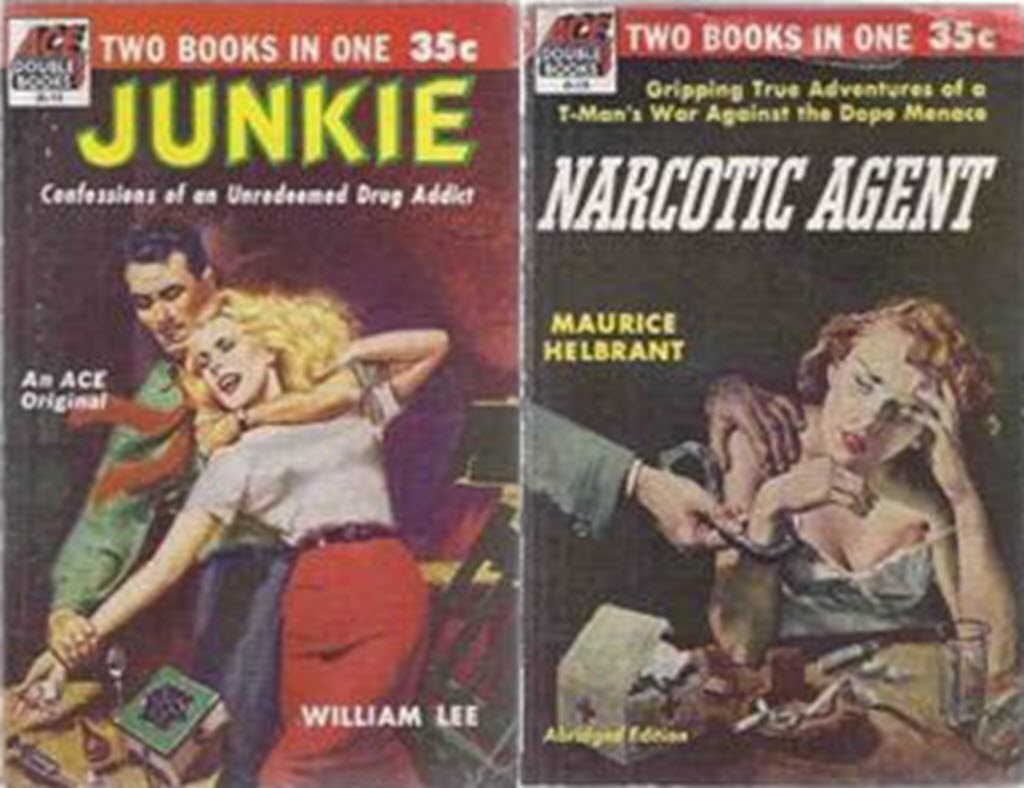
One of the most culturally significant Ace Doubles was the debut novel of William Burroughs, Junkie, published under the pseudonym “William Lee,” a gritty semi-autobiographical account of heroin addiction. To make it palatable to censors, it was paired with Narcotic Agent by Maurice Helbrant, a reprint of a memoir by a Federal Bureau of Narcotics agent.
Science fiction doubles
Science fiction was Wollheim’s true passion. In October 1953 he published the first science fiction Ace Double, A E Van Vogt’s The World of Null-A, the first paperback appearance of an award-winning 1945 hardcover. It was paired with The Universe Maker, a distinctly lesser Van Vogt novella which is only notable because it has some early references to L Ron Hubbard’s Dianetics, then in its infancy. (Did you know Hubbard was a prolific SF pulp writer in the 1930s and 1940s? He wasn’t good at it but he was friends with Golden Age authors like Van Vogt and Heinlein.)
SF readers are voracious and they were accustomed to novella length stories from pulp SF magazines. Wollheim made the doubles more attractive by reprinting a book by a known commodity paired with a new novel from a lesser-known author. He bumped up the schedule to one science fiction Ace Double per month, a schedule that was maintained for more than fifteen years. Covers were gaudy and action-oriented, eye-catching even if occasionally they had nothing whatsoever to do with the book inside.
Ace’s science fiction titles quickly overtook its other genres. Along with Ballantine Books, Ace was one of the two dominant science fiction paperback publishers in the 1950s and 1960s.
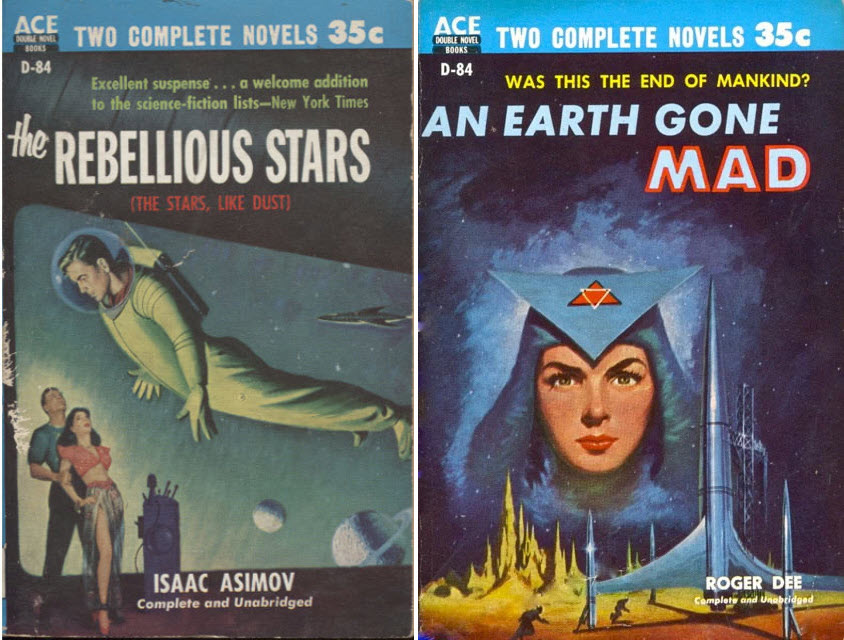
Wollheim enforced the manuscript guidelines with a heavy hand, cutting long manuscripts without the author’s permission and sometimes with their knowledge. Isaac Asimov was furious when Ace published his novel The Stars Like Dust in 1954 - Wollheim retitled it The Rebellious Stars and made huge cuts to the text without bothering to tell Asimov before it appeared on the newsstands. John Brunner repudiated his novel Castaway’s World when it appeared in an Ace Double because of unauthorized cuts.
It is a fond legend of fandom that if Donald Wollheim had gotten hold of the Old and New Testaments, they would be published as an Ace Double titled War God of Israel / The Thing With Three Souls.
Philip K Dick
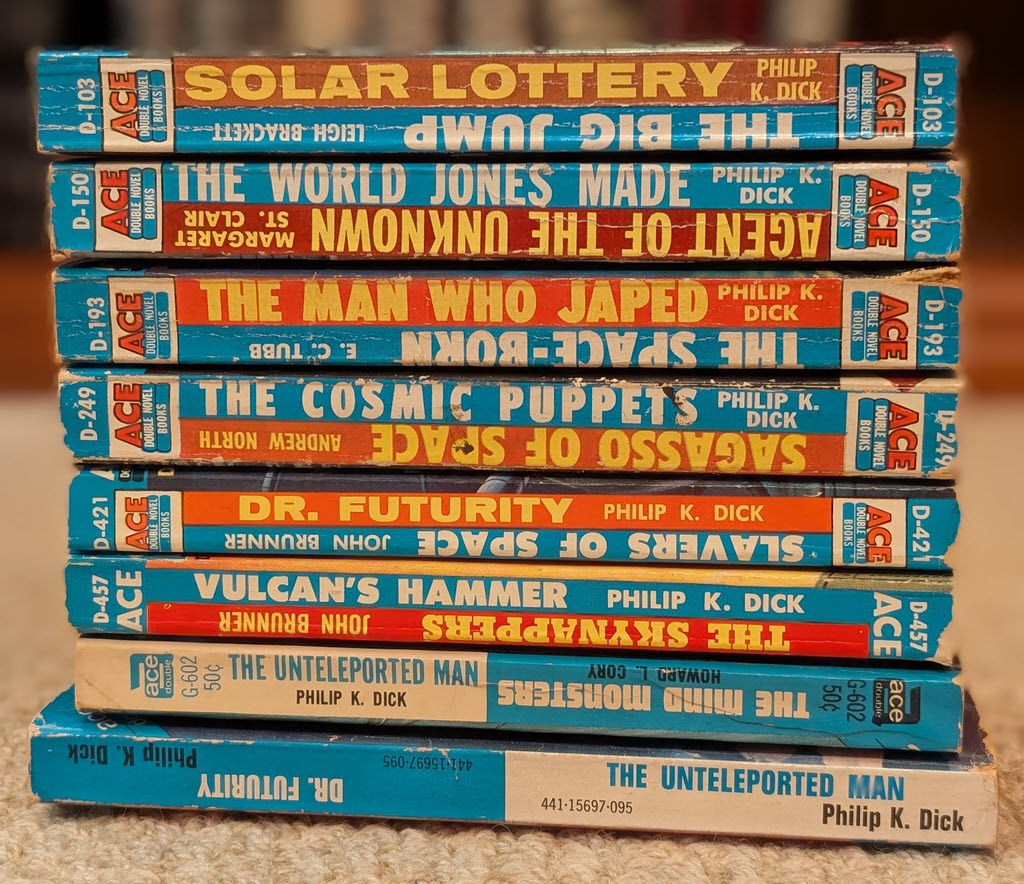
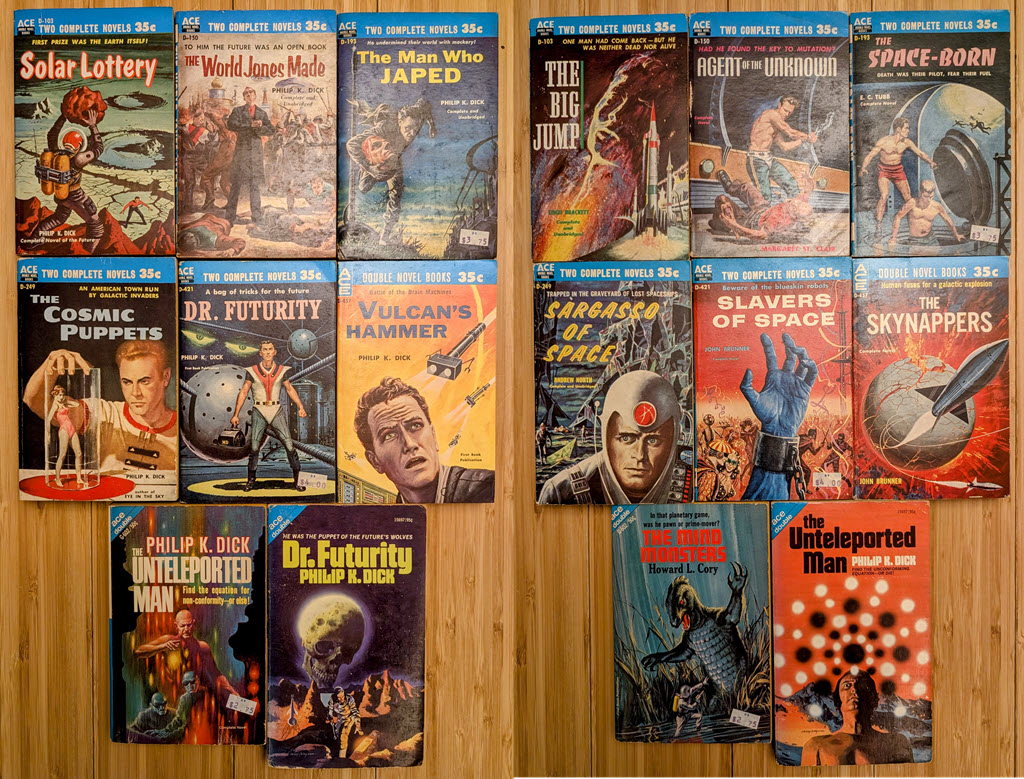
Philip K Dick is the author most closely associated with Ace Doubles - a total of eight releases over the years, including his debut novel Solar Lottery and other novels from early in his career. Dick’s novels are not exactly typical space opera pulp material - Dick’s obsessions were the crumbling of reality, drug-induced paranoia, and the tragedy of the little man.
Dick escaped from Ace paperbacks when his first hardcover title, Time Out Of Joint, was published in 1959. He was formally recognized as a major talent when The Man In The High Castle won the Hugo in 1962. Over the next twenty years he wrote many more novels that balanced high-concept SF with ambitious philosophical questioning. Now he is one of the most influential SF authors of all time, with more movies and TV shows adapted from his work than any other SF author in the last sixty years.
Ace Doubles were a big part of his career at the beginning.
Don’t go looking for Ace Doubles unless you’re a particularly committed type of collector. They were printed on cheap paper and fall apart easily. But I heartily recommend taking time for a PKD novel or two. They’re always entertaining and always, always, weirder than you expect.