
Psst. Come in, come in! I’ve got a weird and wonderful book for you.
There are books that feel like neatly arranged shelves. Then there are books like The Circus of Dr. Lao, which feels more like someone opened a door in the back of the room and a carnival wandered in, trailing incense and a faint sense that something important happened when you weren’t looking.
Yes, it’s deeply strange. You’ve read my articles before, right? I assume that’s not a surprise.
If you’ve never heard of The Circus of Dr Lao, you’re not alone. It’s one of those quietly influential works that has spent ninety years since publication hovering just outside the mainstream, beloved by writers and occasionally rediscovered by readers.
Let’s step inside.
A plot that refuses to behave
The story begins in the dusty Arizona town of Abalone in 1935. Abalone is a small-town snapshot of Depression-era Americana, populated by insurance salesmen, lawyers, and housewives whose lives are defined by boredom and surviving the Great Depression.
One day, a mysterious traveling circus arrives, run by the enigmatic Dr. Lao. But this is not a circus of elephants and trapeze artists. It’s a gathering of creatures from myth, legend, and nightmare: a medusa, a satyr, a sphinx, a sea serpent, and more.
From there, the book unfolds less like a traditional narrative and more like a stroll through a mythological midway. The abominable snowman dismantles the certainty of a skeptical man without ever raising his voice. The satyr entices a prim, self-controlled woman into a brief, dizzying confrontation with desire. The werewolf reveals the animal lurking beneath polite society.
Characters drift in and out. Townspeople encounter the exhibits, and each encounter becomes a kind of personal revelation or confrontation. Some are enlightened. Some are disturbed. Some barely notice anything unusual at all. And toward the end, the tone darkens into something stranger and more ritualistic, culminating in a bizarre pagan ceremony involving a god called Yottle and a series of unsettling deaths.
Then, just as abruptly as it arrived, the circus leaves. The town disperses. Life resumes. But not quite unchanged.
Publishing history
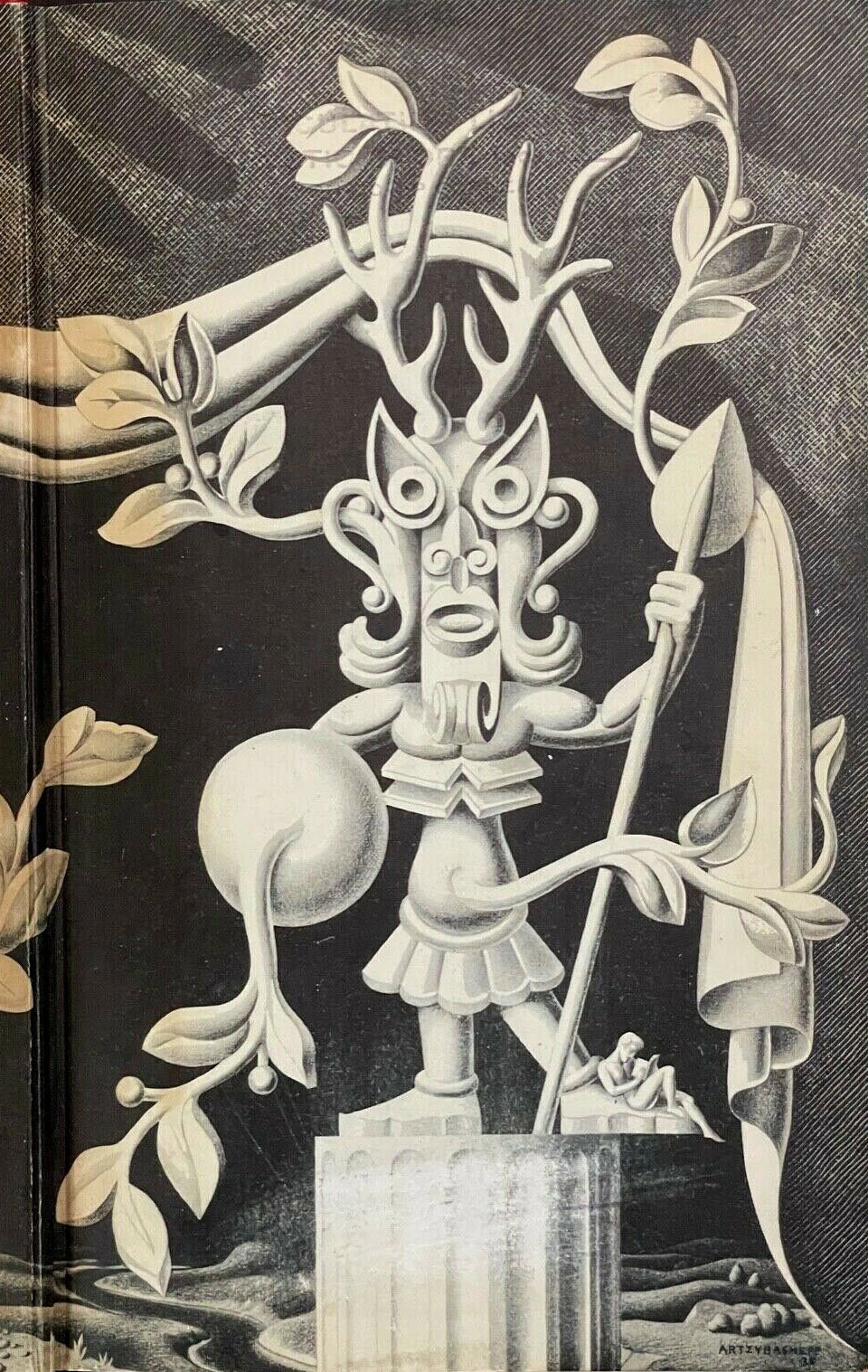
Charles G. Finney published The Circus of Dr. Lao in 1935. It was his first novel, conceived during his time in China and written after his return to Arizona.
From the beginning, the book was recognized as something unusual. Critics were intrigued, amused, bewildered. It won one of the very first National Book Awards, in a category called “Most Original Book.” That category no longer exists, which feels oddly appropriate. This is not a book that fits comfortably into categories. It has never gone out of print.
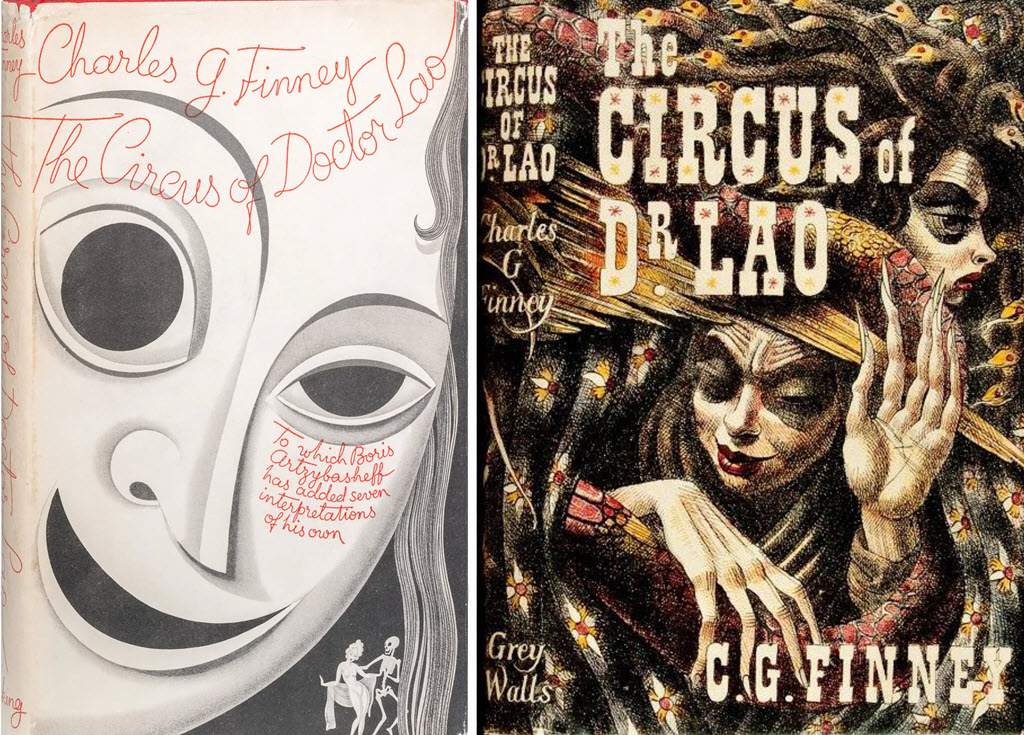
Boris Artzybasheff supplied the Daliesque illustrations in the 1st US edition. Gordon Fish used a darker tone for the 1st UK edition in 1948. The photo at the top shows the 1935 Viking edition on the left, the 1948 Grey Walls edition on the right.
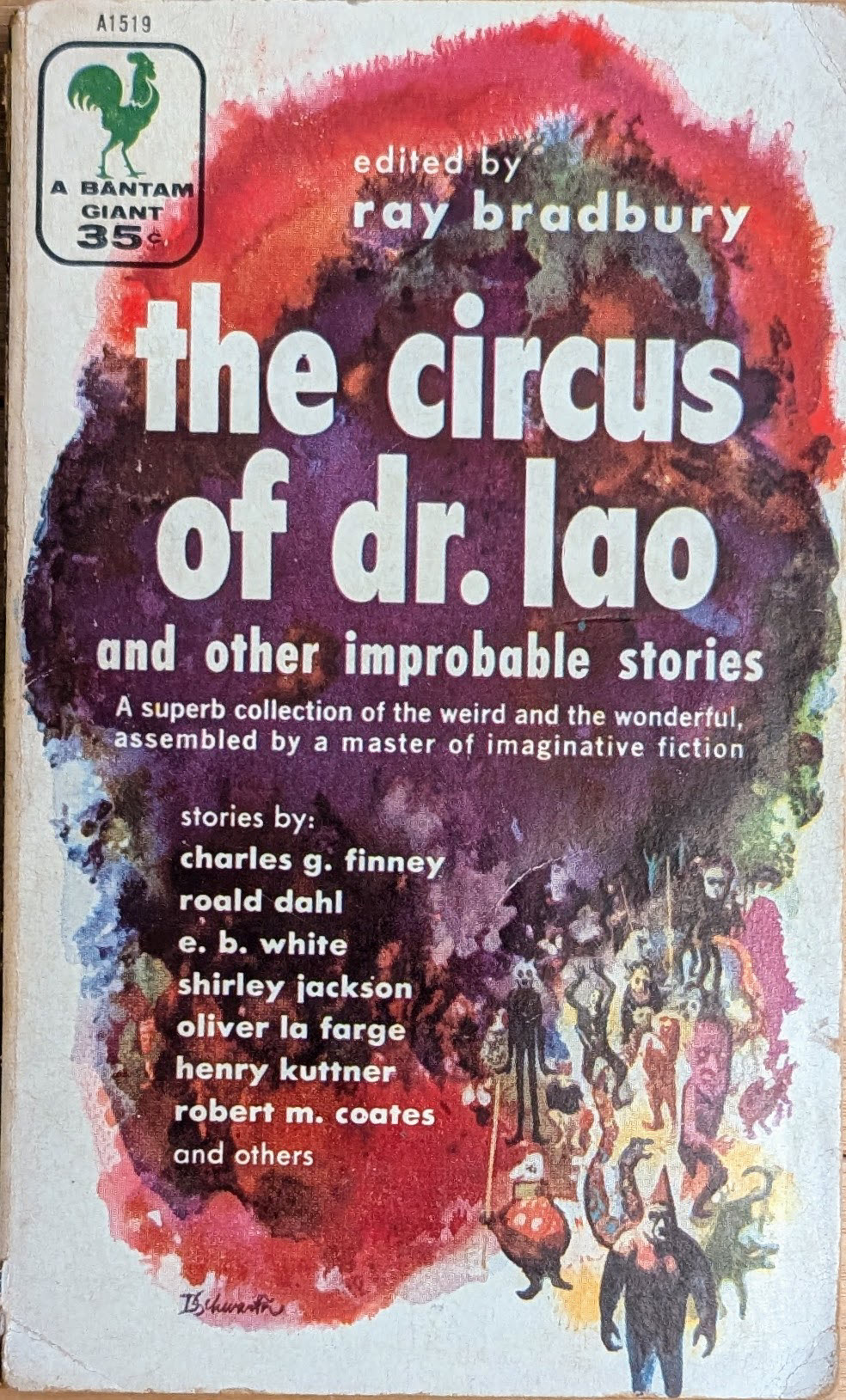
The copy that means the most to me was published in 1956 - the first paperback publication of The Circus of Dr Lao, in an anthology edited by Ray Bradbury. That’s my copy pictured above, bought for thirty five cents when I was twelve years old. I felt like I’d stumbled into something slightly forbidden. I returned every so often and each time it stayed just ahead of me, waiting for me to catch up.
The dark carnival in Bradbury’s novel Something Wicked This Way Comes was an homage to The Circus of Dr Lao. More recently, Peter Beagle called it “one of the most remarkable books ever written” and a direct inspiration for the Midnight Carnival in his beloved novel The Last Unicorn.
In 1964 the novel was transformed into 7 Faces of Dr Lao, a family-friendly movie starring Tony Curtis Randall as the enigmatic Chinese circus owner. It’s an entertaining movie, with stop motion animation and Tony Randall transformed into seven different roles - Merlin, the medusa, the serpent, and more. But the dark edges of the book are sanded away and a routine plot is stitched in and from this distance it’s hard to forgive casting Tony Randall as an Asian character in yellowface with heavy makeup and exaggerated mannerisms.
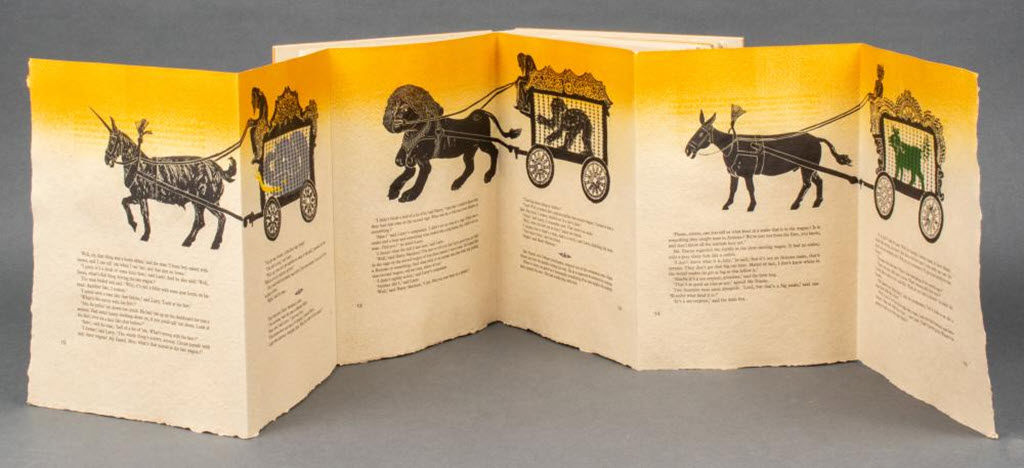
Collectors’ note: Clair Van Vliet contributed etchings for a distinctive Limited Editions Club version in 1982, then published them in an upgraded edition from Janus Press in 1984, one of the most impressive modern America private press books of all time. The only copy available for sale today on Abebooks is listed at $6,600.
An odd novel, beautifully written
The Circus of Dr Lao doesn’t read like a relic. It’s only 150 pages and written with a brisk, amused intelligence that feels modern. But it’s not like a conventional fantasy novel - it’s stranger, more elliptical, quietly unsettling. It’s funny but not always comfortably so. It’s about a circus but also about perception, belief, and the limits of understanding. And there’s a 20 page catalog at the end listing every character, creature, and concept in the story with sly commentary, cheerfully pointing out inconsistencies and unanswered questions, as if the author is leaning over your shoulder saying, yes, I noticed that too.
Maybe I can tempt you with a sample of particularly luminous writing.
Apollonius of Tyana is a fortune teller who delivers prophecies that are always accurate and rarely comforting. His gift and his curse is that he can only speak the truth, without distortion or mercy. Mrs. Cassan visits him in his circus tent expecting the usual soft-focus fortune telling, something flattering and gently reassuring. She does not get that.
This is glorious writing that makes you want to slow down, not because it’s difficult but because you don’t want to rush past it. Enjoy!
The widow Mrs. Howard T. Cassan came to the circus in her flimsy brown dress and her low shoes and went direct to the fortuneteller's tent. She paid her mite and sat down to hear her future. Apollonius warned her she was going to be disappointed.
"Not if you tell me the truth," said Mrs. Cassan. "I particularly want to know how soon oil is going to be found on that twenty acres of mine in New Mexico."
"Never," said the seer.
"Well, then, when shall I be married again?"
"Never," said the seer.
"Very well. What sort of man will next come into my life?"
"There will be no more men in your life," said the seer.
"Well, what in the world is the use of my living then, if I'm not going to be rich, not going to be married again, not going to know any more men?"
"I don't know," confessed the prophet. "I only read futures. I don't evaluate them."
"Well, I paid you. Read my future."
"Tomorrow will be like today, and the day after tomorrow will be like the day before yesterday," said Apollonius. "I see your remaining days each as quiet, tedious collections of hours. You will not travel anywhere. You will think no new thoughts. You will experience no new passions. Older you will become but not wiser. Stiffer but not more dignified. Childless you are, and childless you shall remain. Of that suppleness you once commanded in your youth, of that strange simplicity which once attracted a few men to you, neither endures, nor shall you recapture any of them any more. People will talk to you and visit with you out of sentiment or pity, not because you have anything to offer them. Have you ever seen an old cornstalk turning brown, dying, but refusing to fall over, upon which stray birds alight now and then, hardly remarking what it is they perch on? That is you. I cannot fathom your place in life's economy. A living thing should either create or destroy according to its capacity and caprice, but you, you do neither. You only live on dreaming of the nice things you would like to have happen to you but which never happen; and you wonder vaguely why the young lives about you which you occasionally chide for a fancied impropriety never listen to you and seem to flee at your approach. When you die you will be buried and forgotten, and that is all. The morticians will enclose you in a worm-proof casket, thus sealing even unto eternity the clay of your uselessness. And for all the good or evil, creation or destruction, that your living might have accomplished, you might just as well have never lived at all. I cannot see the purpose in such a life. I can see in it only vulgar, shocking waste."
"I thought you said you didn't evaluate lives," snapped Mrs. Cassan.
"I'm not evaluating; I'm only wondering. Now you dream of an oil well to be found on twenty acres of land you own in New Mexico. There is no oil there. You dream of some tall, dark, handsome man to come wooing you. There is no man coming, dark, tall, or otherwise. And yet you will dream on in spite of all I tell you; dream on through your little round of hours, sewing and rocking and gossiping and dreaming; and the world spins and spins and spins. Children are born, grow up, accomplish, sicken, and die; you sit and rock and sew and gossip and live on. And you have a voice in the government, and enough people voting the same way you vote could change the face of the world. There is something terrible in that thought. But your individual opinion on any subject in the world is absolutely worthless. No, I cannot fathom the reason for your existence."
She started to say more, but there was no longer anyone to talk to. Apollonius had vanished.
(Emphasis added because it's even more terrible in 2026.)
Tony CURTIS? You mean RANDALL, surely!
Incidentally, Ray Bradbury denied the influence of Finney. He maintained that he had not read Dr Lao when he wrote Something Wicked (originally as a screenplay in 1955, later adapted into his 1962 novel).
Phil Nichols
Bradbury 100 Podcast
I proofread over and over and still got the wrong Tony. Thanks for the catch!
That’s a fascinating extra insight about the timing – I didn’t know Bradbury denied the direct connection, I just assumed he had grown up with Dr Lao. Interesting!