
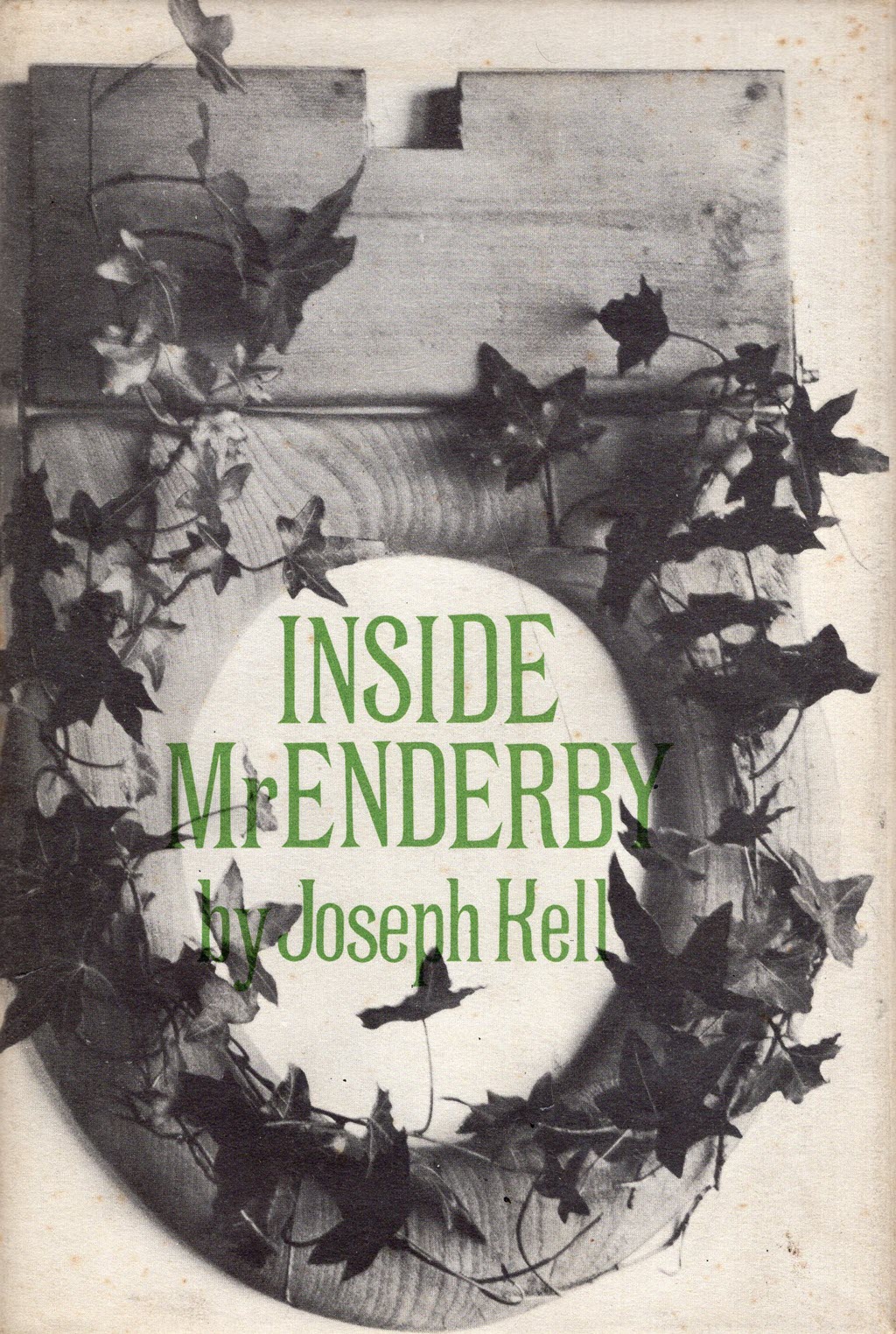
Inside Mr Enderby is one of my favorite novels, written by renowned British author Joseph Kell and published in 1963. The book follows the life of F.X. Enderby, a dyspeptic poet who lives a solitary life of writing and intestinal eloquence until he is seduced by a glamorous widow who attempts to reform him.
The 1960s were a golden age for literary novelists - Graham Greene, Kingsley Amis, Vladimir Nabokov, J.G. Ballard. One of the literary greats, Anthony Burgess, author of A Clockwork Orange, reviewed Inside Mr Enderby for the Yorkshire Post. His review was quite critical:
“This is, in many ways, a dirty book. It is full of bowel-blasts and flatulent borborygms, emetic meals ('thin but over-savory stews,' Enderby calls them) and halitosis. It may well make some people sick, and those of my readers with tender stomachs are advised to let it alone. It turns sex, religion, the State into a series of laughing-stocks. The book itself is a laughing-stock.”
You don’t recall the author’s name “Joseph Kell”? He had previously written another comic novel, One Hand Clapping - does that help? Alas, no, he’s mostly forgotten now.
That’s because there’s a surprise twist. It was particularly a surprise to the editor of the Yorkshire Post, who had published Burgess’ review.
Because “Joseph Kell” was a pseudonym for Anthony Burgess. He had sent the newspaper a review of his own novel and they published it.
It caused a fuss when a competitor wrote a complaint about it a few days later. Burgess was sacked as the Yorkshire Post reviewer. It is now considered a classic literary hoax.
There were no lasting effects on Burgess’ career. In his telling, it’s more of a misfired joke than an attempt to mislead anyone. I’ll tell you the story not because it has deep significance, but because I’ve had more fun and spent more time reading Anthony Burgess’ novels in my lifetime than any other author and some readers - maybe you! - should discover him.
The brain tumor
Burgess started his career as a novelist with three books written while he was teaching in Brunei in the late 1950s.
Everything changed when he collapsed in a classroom in 1959. He was flown back to London and diagnosed with an inoperable brain tumor. The doctors at the Neurological Institute told him he had one year to live.
Believing his wife, Lynne, would be left destitute, Burgess set a goal to write enough books in that single year to provide her with a steady stream of royalties after he was gone. He wrote six novels in the next 12 months.
By the end of 1960, he realized he wasn't dying. In fact, he felt better than ever. He eventually concluded that his illness had been a combination of severe tropical exhaustion and the effects of heavy drinking.
Nonetheless, the books were ready to be published and he was still writing. Two or three of his novels were released each year beginning in 1960, ranging from political satires to dystopian SF to comic novels about suburban life.
A Clockwork Orange was one of those novels, published in 1962. Critics responded with bafflement, repulsion, and occasional qualified praise. It sold fewer than 4,000 copies in the next few years.
The publisher objected to flooding the market with so many novels in a short time by the same author. Burgess agreed to release two of them under the pseudonym Joseph Kell. Inside Mr. Enderby was the second of those, published a year after A Clockwork Orange.
Reviewing his own book
Burgess needed money for his life in London. He started reviewing novels for the Yorkshire Post. Weekly parcels of new books arrived, so many that the local post office had to take on extra staff to cope with the volume of mail. Burgess sold review copies of the books for half price to get cash for groceries. During the same period, he was reviewing television for the Listener, making TV and radio programmes for the BBC, and writing more novels.
When a copy of Inside Mr. Enderby arrived in a parcel from the Yorkshire Post, Burgess assumed that the editor was in on the joke, and he wrote a review which was published on 16 May 1963 under the headline “Blasts from the Smallest Room.”
Burgess wrote about the response in his memoir:
“I was surprised at the response of the literary world to this harmless piece of foolery. A week after the publication of the review The Daily Mail disclosed that Joseph Kell was really Anthony Burgess, who had chosen a disguise in order to be paid for advertising his own work. [Yorkshire Post editor] Kenneth Young appeared on Granada Television to denounce my treachery and summarily, in public, to fire me. There was no response of either regret or satisfaction from Yorkshire Post readers, who first as last ignored me when I was not writing about inodorous orchids. I gained temporary fame as a literary villain.”
The great man of letters
The release of Stanley Kubrick’s movie of A Clockwork Orange in 1971 rocketed Burgess to reluctant celebrityhood. Earthly Powers, published in 1980, was a massive, ambitious novel hailed as his masterpiece, shortlisted for the Booker Prize and winner of major awards in France. By the time he died in 1993, Burgess was viewed as one of the most prodigiously gifted European writers of the century, compared often to Evelyn Waugh and James Joyce.
I read all of Burgess’ thirty-plus novels and understood many of them. I had the pleasure of hearing him speak at my college in 1976, at which he told the story of sitting in on a college lecture about Inside Mr Enderby. He identified himself to the professor after the lecture and pointed out that several of the professor's interpretations regarding the symbolism and hidden meanings were simply incorrect and not what he had intended at all.
The professor, unfazed, looked at him and said, "Just because you wrote the book, what makes you think you know anything about it?"
Burgess made it clear he had no patience for the idea of a critic (or a professor) overriding an author’s creative logic.
I’ll leave you with a single example of Burgess’ love of language and the playfulness of words and grammar, a sequence in the sequel Enderby Outside that Jim Rowson and I quoted to each other for the rest of our lives, laughing every time. I imagine him setting a challenge for himself - two sentences constructed so the same word appears four times in a row in a way that is grammatically permitted.
Then, instead of expensive mouthwash, he had breathed on Enderby bafflingly (for no banquet would serve, because of the known redolence of onions, onions) onions.
"Onions," said Enderby.
Is that great or what?
Pfffrrrummmp.
And a very happy New Year to you too, Mr Enderby, Mr Burgess, and Mr Kell!
NOTE FOR READERS: Don’t start with A Clockwork Orange - it’s notoriously difficult to read because it features a fictional teenage slang that initially looks like gibberish. "Our pockets were full of dengy, so there was no real need even to tolchock some old veck in an alley and viddy him swim in his own krovvy."
Earthly Powers is a big book in every sense - big religious and moral themes, big stylistic flair with no holds barred on vocabulary, and big page count. It’s extraordinary but it’s not light reading.
You can dive in with Inside Mr Enderby to see if Burgess suits your taste. He wrote three more Enderby books, with all four published together in the last few years as The Complete Enderby. Or consider The Wanting Seed, dystopian SF with the same speculative energy as A Clockwork Orange but in standard English; The Right To An Answer, colonial satire reminiscent of Kingsley Amis or Graham Greene; or Nothing Like The Sun, a recreation of Shakespeare and his world written in a lush pseudo-Elizabethan prose.