
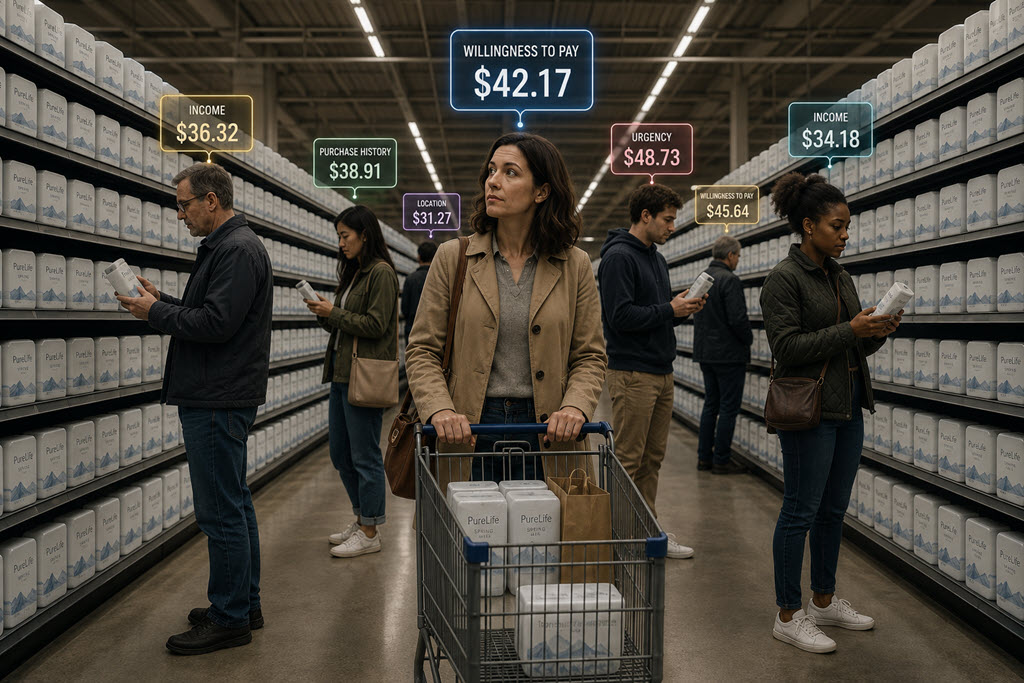
I’ve been telling you for years that data about you is being accumulated and sold by tech companies, data brokers, retailers, law enforcement agencies, telecom carriers, financial institutions, insurance brokers, employers, and, well, basically everything about who you are and every single thing you do in private or in public is studied and logged by forces you can’t see or control.
Until now I’ve soft-pedaled that, for two reasons: I hate to see you cry; and I thought if the only thing that happens is that we get targeted advertising, that’s not so bad.
I was wrong. I underestimated the shittiness of the world and the immorality of large companies, and now AI is being used to supersize the badness. There’s nothing any of us could have done differently but I should have seen this coming.
We’re going to talk about surveillance pricing and algorithmic wage discrimination. My articles are short, so this will mostly be inflammatory anecdotes, but I don’t think I’m misrepresenting anything.
So: trigger warning. This is one of the dark things going on today that you’d rather not know about.
Surveillance pricing
For over a century, we’ve relied on the assumption that there is a single transparent price for everyone. You could compare, you could budget, and you knew what your neighbor paid for the same item.
Remember the annoyance you first felt ten years ago or so when you realized people sitting beside you on the plane might have paid less than you for their ticket?
Today you should assume that no one is paying the exact same price that you are charged for almost anything.
The fixed price is dead. You are charged according to the desperation of your need. Your browsing history, location, income, purchases, and weaknesses are ingredients in an algorithmic recipe for gouging the maximum amount of money out of your wallet, the precise point where you will scream but still click BUY.
A parent is searching for emergency medical supplies in the middle of the night. The shopping site tracks a shopper’s search history, purchase history, and cues like opting for fast delivery of infant formula, and concludes it is dealing with a rushed and stressed parent, so it tweaks search results to display high-priced baby thermometers on the first page and adds a premium to the price because the parent is probably too upset to do any comparison shopping.
Travel sites measure your desperation, scanning your calendar and studying your search frequency and location. You might be shown a massively inflated fare when you’re trying to book urgent last-minute travel to get home for your father’s funeral.
These examples are drawn from Congressional hearings and FTC studies. AI analyzes data about you – everything from your age, race, and gender, to your location (a proxy for your household income) and your browser history (items lingering in carts, repeated visits, mouse movements) – and predicts your pain point, the maximum price you’ll tolerate before abandoning the purchase.
The price is entirely disconnected from the actual cost of the product.
And it won’t always be the price that is ratcheted up or down. Perhaps your neighbor will get a banner offering a 15% discount because he has proven he’s a sucker for coupons, but you don’t see it because the algorithm knows you’re likely to buy anyway. Or maybe the third time you look for the same airline fare, you see a warning that “only 1 seat left at this price,” or a countdown timer with ten minutes left for a discount – all fictional, all intended to provide a burst of psychological pressure.
Target’s app charged higher prices when users were sitting in the store parking lot. Orbitz steered Mac users to pricier, more upscale hotels than people browsing on PCs. Instacart was caught marking up some shoppers’ identical items by as much as a third during “pricing experiments.” Princeton Review charged systematically higher SAT tutoring prices in zip codes with larger Asian-American populations. Uber charged higher prices for pickups or dropoffs in neighborhoods with a higher proportion of black residents.
Companies engaged in surveillance pricing will swear they are not racist. A shopper’s race isn’t even an input.
But AI doesn’t have to learn your race. It only has to learn the economic consequences of your race. People in certain neighborhoods have fewer nearby supermarkets, customers with less acess to transportation are less likely to comparison shop, some customers are less likely to abandon shopping carts when prices rise, and the AI might incorporate income and credit information into its analysis.
And somehow as if by magic, the results are racist but everyone involved can deny it.
The black box
The industry describes AI analysis as a “black box”: data goes in, a decision comes out, but there’s no meaningful explanation of how it got to the result. If you get denied for a car loan even though you have a good job, steady income, and solid credit history, you will never know why – you can’t identify the offending information, challenge its relevance, or correct it if it’s wrong. The loan officer will point to the black box and shrug her shoulders.
We have left transparency far behind. The incentives are always going to lead to unfair or discriminatory treatment unless it is explicitly forbidden.
Frequently you won’t know that a computer is negotiating with you. Every life interaction may be mediated by a machine trying to estimate the least favorable deal you are likely to accept. College admissions officers use AI modeling to estimate which applicants are likely to enroll. There is no “tuition cost” any more. The system decides, what is the minimum aid package it can offer that will be sufficient to close the sale for a particular student.
But the most insidious use of AI and surveillance data is shaping labor markets today in our gig economy. If an AI-driven system is asked to minimize labor costs while maintaining supply, the system will inevitably discover that economic vulnerability is a feature, not a bug.
The result: desperation is being weaponized.
Algorithmic wage discrimination
Equal work does not lead to equal pay. Women have known that for generations. Today, though, the inequality comes from opaque decisions by a black box that is trained to optimize human desperation. UC Irvine Law Professor Veena Dubal coined the term “algorithmic wage discrimination” to describe the “unpredictable, variable, and personalized hourly pay” for on-demand workers.
Uber drivers are not all offered the same pay to pick up a passenger. Algorithms are constantly tweaking the offers to find the lowest amount a driver will accept. An Uber driver typically has 15 seconds to look at an algorithmically calculated pay offer and decide whether to accept it. A driver who is cash-strapped will take lowball offers to avoid missing out.
Nursing has entered the gig economy, with per diem shifts showing up in Uber-like apps on nurses’ phones. The apps check how much credit card debt a nurse is carrying and whether the debt is delinquent to measure the desperation that nurse feels for getting work that day, lowering the offered wage because AI predicts they need the cash and so they’re likely to accept. A study by the Roosevelt Institute found that this routinely produces situations where nurses are paid materially different amounts for performing identical work at the exact same facility.
Major companies scrape consumer databases so labor/management AI vendors can calculate the absolute minimum compensation a specific worker will accept before quitting or looking elsewhere. They’ll scrape social media and public information about job seekers to see if they’re likely to join a union or become pregnant, then pass that information into the black box for hiring, scheduling, and pay-setting. Carrying credit card debt, taking out a payday loan, mentioning your debt load on social media – all might lead to lower wages in the future.
Amazon delivery drivers (employed by subcontractors) use in-van AI surveillance cameras. The wrong eye movements, even looking in an unapproved direction in reaction to another car cutting them off, can lead to loss of bonuses or dings on the scorecard used to set wages. Amazon’s warehouse workers are tracked to the second by the Time Off Task system, with automatic warnings and terminations without human involvement for time spent talking to managers or waiting for a broken conveyor belt to be repaired.
Insurance and financial services companies use AI software to analyze agents’ voice tones and speech patterns during customer calls to calculate an emotional and engagement score. The score influences performance reviews, promotions, and compensation – and systematically penalizes neurodiverse workers, older employees, and non-native speakers with accents.
There are protections for employees in our outdated labor laws. Firms misclassify workers as independent contractors to sidestep those protections. Gig companies point to “the app” as the magical reason they should be excused from treating employees fairly. When they set dynamic wages that are discriminatory and unfair, the companies can point to the black box and shrug.
Companies say they aren’t trying to exploit workers. They’re “improving marketplace efficiency.” They’re “maximizing filled shifts subject to cost constraints.”
The federal government response
In January 2025 the Federal Trade Commission released a major report titled “FTC Surveillance Pricing 6(b) Study.” The FTC staff discovered that companies harvest a massive and intrusive array of personal data and behavioral signals to estimate a customer’s willingness to pay and price sensitivity. Intermediaries running AI systems on surveillance data were managing pricing systems for at least 250 major enterprise retail clients.
Congress claims to be working on “bipartisan” regulations and has held high profile hearings this year to follow up on the FTC report. Good lord, you’re not actually thinking that Congress or the Trump FTC will do anything meaningful, are you? You’ve been alive for the last 18 months?
The reality is that after a brief crackdown under Biden, the Trump regime has been extraordinarily welcoming to surveillance pricing companies, dropping investigations and cases against firms that engaged in the practice.
A few states are stepping in. California is grinding away at a smart bill that bans surveillance pricing. “Advocating against it are state Republican lawmakers, and retail and tech-industry groups,” according to the San Francisco Examiner. Companies like Uber and Lyft are fiercely lobbying against state bills that might slow down the use of surveillance pricing and algorithmic wage discrimination.
What can you do?
Oops! The Bruceb News algorithm has determined that I do not qualify for more words. The app is optimized to avoid logorrhea and I don't get an expla