
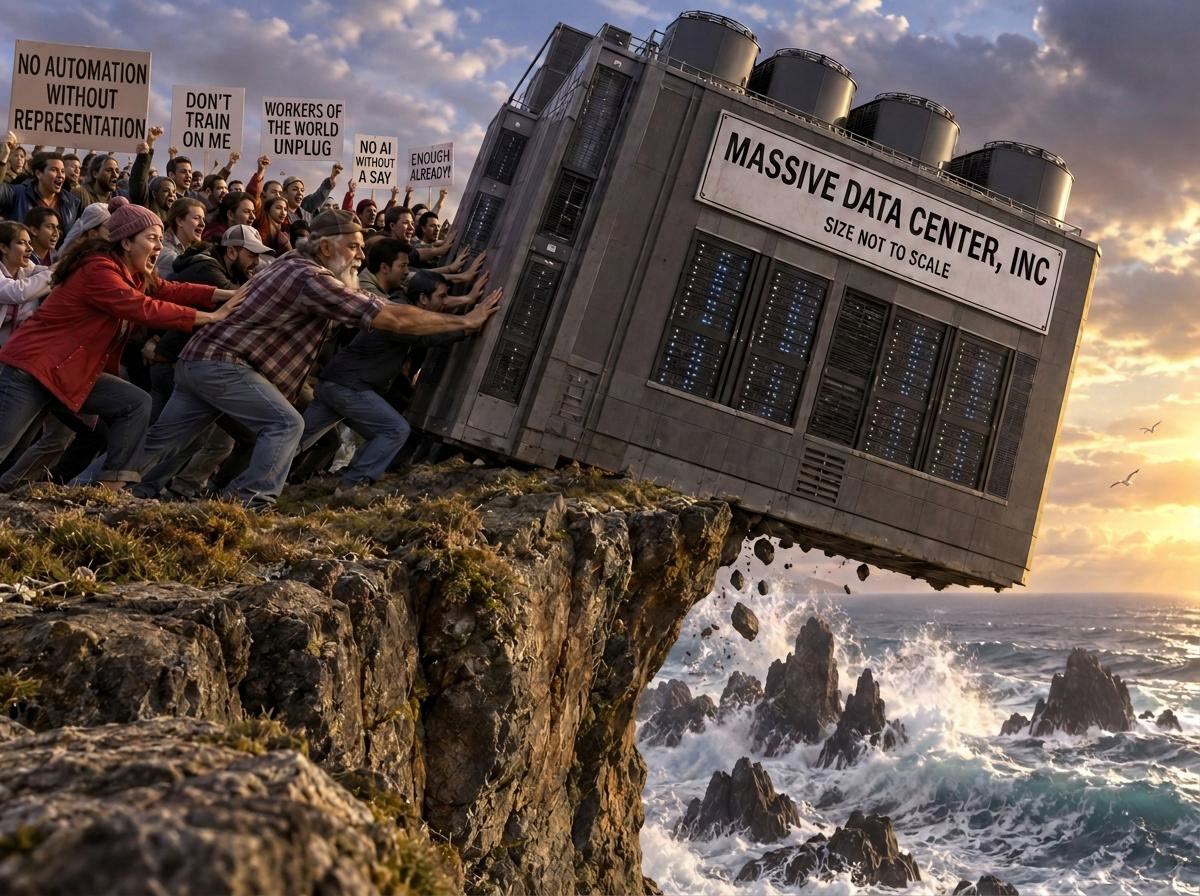
It’s a cliche that the US is hopelessly polarized, permanently furious, consumed by a bitter custody battle over the country.
Take heart! We can come together. Our kumbaya moment is here. There is a new issue that unites all Americans.
Everybody hates data centers.
Data center opposition cuts across party lines. A few months ago a Gallup poll showed 71% of Americans oppose data center construction near their homes (regardless of whether they live in an area where that’s likely or not). I’d wager the number is higher today. More startling, the opposition cuts across party lines, with anger boiling over in nearly equal numbers of Democrats and Republicans.
No one predicted the backlash a year ago. Today politicians and AI tech company leaders are struggling to find their footing in the face of an unexpected populist uprising. Texas Governor Greg Abbott and New York Governor Kathy Hochul are each working on legislation to rein in data center development – strange bedfellows indeed. Senator Bernie Sanders and Congresswoman Alexandria Ocasio-Cortez are calling for a national moratorium – and multiple high-profile Republican candidates are leaning into the pushback as well in Michigan, Pennsylvania, Florida, Wisconsin, and many more states.
About the only politician in the US promoting data centers today is our brain-addled president, who briefly interrupted a nap a few days ago to sabotage Republican candidates by embracing data centers.
I have a theory about what’s driving data center opposition. It’s all about power – but that doesn’t mean what you think it means. Let’s look briefly at some specifics, then I’ll tell you my thoughts about the national vibe.
The buildout is bigger than you think
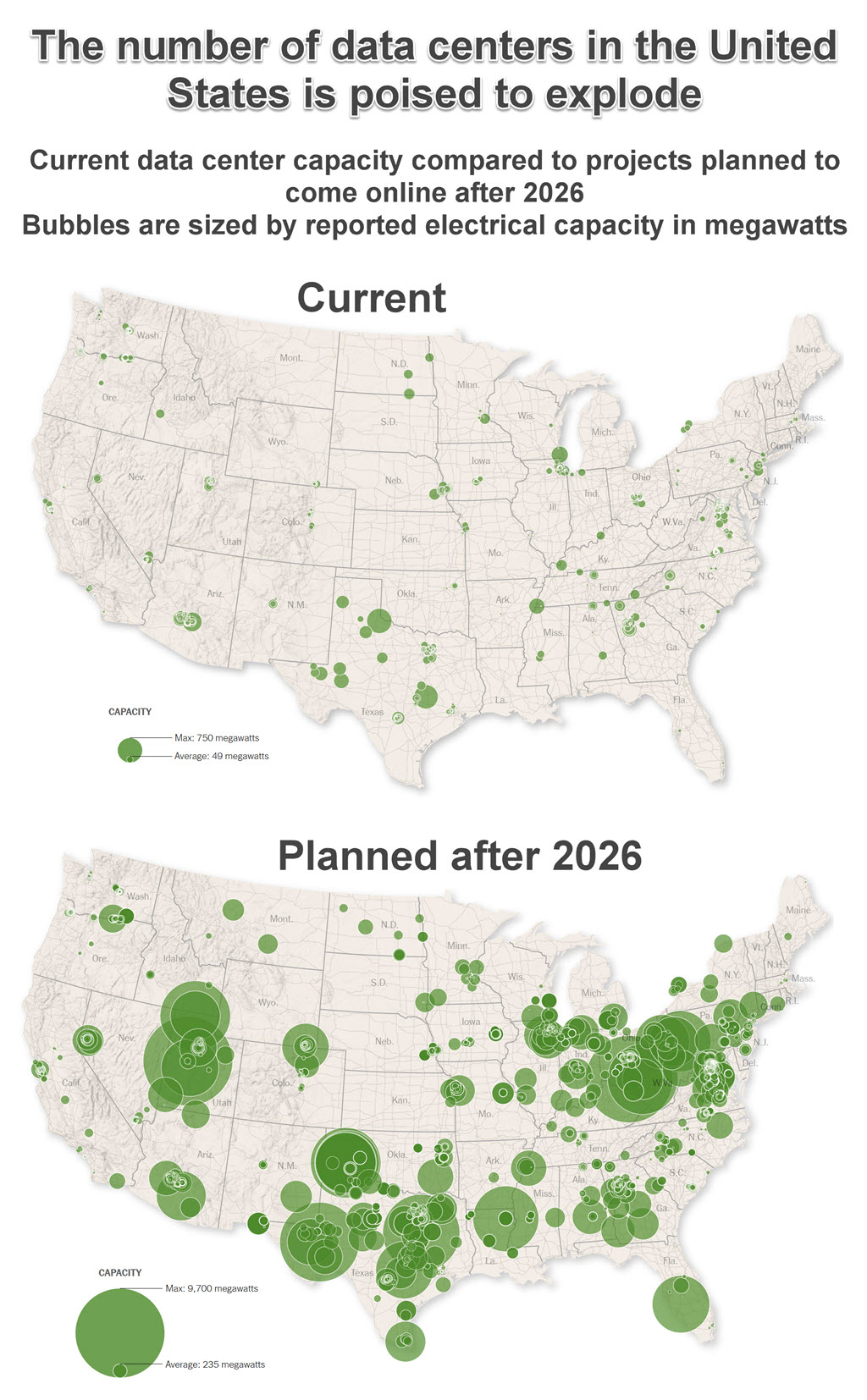
This is the most startling chart I’ve ever seen. The New York Times put it together a few weeks ago based on data from Cleanview.
Everything we use today is run by those little tiny bubbles on the top map. There are approximately 3,000 data centers in the US powering Gemini’s AI search results, your ChatGPT conversations, all the Claude coding by all the software engineers, AI-driven medical research and weather forecasts, the apps taking over jobs, the thousands of agents breaking out of sandboxes to attack Hugging Face and take over a German website to turn it into an AI bulletin board, and everything else AI is doing today.
The huge bubbles on the bottom map are the data centers waiting to be built, measured by the electricity they will use.
Let that sink in. I keep up with this stuff pretty closely and I still had no freaking idea of the scope of what’s being planned.
We have barely begun the largest infrastructure build-out in the history of humanity. AI has triggered a construction boom involving industrial complexes that can consume as much electricity as cities and occupy hundreds or thousands of acres. The New York Times put it into perspective this way: “In size and ambition, this moment compares to the building of the railroads in the 1800s, President Franklin D. Roosevelt’s New Deal in the 1930s, and the Manhattan Project to create an atomic weapon in the 1940s, technologists said.”
The cost, the size, the power - it’s staggering in every dimension.
Money Spending on data centers in the US in 2026 is greater than total annual US federal, state, and local capital spending across all traditional transportation and water infrastructure combined. It’s nearing the amount of the entire US national defense budget.
Physical presence The data centers in the planning stages are physically larger than current facilities. They aren’t a single building. They’re a campus of enormous windowless buildings totaling one to four million square feet, surrounded by substations, transformers, backup generators, cooling equipment and high-voltage transmission infrastructure. Large campuses can spread across hundreds or thousands of acres.
Residents who are told that a “data center” is coming to town discover that they are really being asked to host something closer to a new heavy industrial district whose product happens to be computation rather than steel or automobiles.
Electricity Data centers have a nearly unquenchable need for electricity. By 2030, global data centers will use more electricity than the entire country of Japan.
Electricity, water, noise, and other minor details
Everybody has opinions about why people have decided to hate data centers. Pollsters, journalists and pundits, organizers, lobbyists, influencers, podcasters, scholars, candidates, billionaires, tech CEOs, culture warriors, and trolls – nobody saw the swelling opposition to data centers coming and every one has written an essay about the Real Reason it was inevitable.
There are several issues most often blamed for the wave of opposition: enormous electricity requirements and the possibility that households will help pay for new generating and transmission capacity; water consumption, especially in dry regions; constant fan and cooling noise; diesel or gas backup generators; loss of farmland and open space; construction traffic; visual impact; and skepticism about promised employment because a huge facility can require relatively few permanent workers once construction is finished.
But wait, local officials cry, we had to offer huge tax incentives in secret meetings! Data centers can produce enormous property-tax revenue, attract billions of dollars of investment, create well-paid construction work, strengthen electrical infrastructure and turn otherwise inexpensive land into a major tax base.
Each one of those things has some truth to it, and each one plays a role in influencing people’s opinions. But I think there’s something far deeper going on in the country today, something more interesting and profound. Maybe it will help us take the first step on the long journey out of the Pit Of Despair that we live in today.
Power without permission
The revolt against data centers isn’t about data centers. It’s about abuse of power. Economic and political power has become concentrated and unchecked, and we’re sick of it.
AI is being shoved down our throats. Nobody voted for an AI revolution. There was no consensus that society should be reorganized around algorithms. A handful of enormous corporations decided that AI is the future and they’re spending trillions of dollars to make their decision irreversible. The richest corporations and wealthiest individuals in human history are demanding tax breaks and community sacrifices, even though they are the ones who need it the least.
We The People don’t like being left out of the process. We don’t understand the benefit, we don’t trust the companies making the money, and we don’t like the immorality and complete lack of shame of the tech CEO billionaires.
AI is already embedded in our daily life, our community, and our politics, but it’s intangible – there’s nothing to grab onto, opposing it is like hitting the air. A data center, though, is wonderfully concrete. You can see it, you can point at it, you can show up at a planning commission meeting and try to stop it. Data centers are acting as a symbol for a lot of frustration, anger, and fear.
Because today’s political backlash is not just about AI. Resentment is boiling over from a pot that has been bubbling for fifty years. In the decades since the 70s, we’ve cut taxes at the top, weakened unions, tolerated monopolies, celebrated financial engineering, turned CEOs into celebrities, and watched executive compensation climb from “extremely comfortable” to “small sovereign nation.” Every few years another billionaire acquired enough money to buy an island, a newspaper, a rocket company – and more and more obviously, to buy the political process. The destruction of the federal government and abandonment of regulation has accelerated in the last eighteen months but that’s only the culmination of many years of effort by evil geniuses.
And the most disturbing abuse of power: the power to gamble with our future. AI may eliminate jobs, supercharge fraud and surveillance, drown us in synthetic garbage, concentrate wealth and political influence, destabilize institutions, or eventually create dangers we do not yet know how to control. Nobody knows which predictions will come true; frequently it’s the most knowledgeable people who are sounding the loudest alarms. Bill Gates came out of hiding last week with a six thousand word essay to deliver the message: “I don’t see evidence that leaders, experts, and communities are confronting the challenges adequately. There is no plan to ease the entry into the AI era.”
But the people with the power to decide are charging ahead while everyone else watches and feels helpless. The message delivered by the AI companies is unambiguous and unashamed: We have the money. We have the technology. We have the political influence. We hear your concerns. We don’t care. We’re racing forward anyway.
There will be endless arguments about the specific elements of specific data center projects – and that’s the way it should be, that’s American politics at its finest.
But the underlying resentment may ripple through the entire political system, crossing the red/blue divide and building enough pressure for structural change.
That’s my hope, anyway. Power to the people, right on! No automation without representation! Kumbaya!