

You can get answers to all your questions from the AI app in your pocket. Ask any question that occurs to you, no matter how obscure or embarrassing or stupid or trivial. It’s amazing, it’s life-changing, use it, make it your friend. Don’t refuse out of some sense of principle. Do you know what Mark Zuckerberg will do if you refuse to use AI because you want to send a message to the big AI companies? He’ll whack your message with his polo mallet and kick it into his swimming pool and have a good laugh at your expense.
But I kinda need to mention the dark side, because everything about AI has a dark side and you might as well hear it. What if having all the answers makes it harder for us to understand anything?
Information is not knowledge. The struggle is part of the learning. Readily available information may mean less retention, less thoughtfulness, and ultimately less wisdom.
Whoa, heavy, man. Sounds like late-night dorm room stuff, right? But it’s not just theoretical - there are some real world consequences playing out in the news right now.
The school problem
There has been a progression in education that you’ve never noticed but when I point it out you’ll say, oh, that’s obvious.
For most of history, being educated meant you knew things. It was the age of memorization – dates, vocabulary, multiplication tables, scientific principles, literary works.
But the explosion of published knowledge after the invention of the printing press started a long shift. During the library age, being educated meant you knew how to find things. When I was in school in the sixties, I spent as much time learning where to look for information as I did memorizing geography. It was the era of card catalogs, indexes, bibliographies, encyclopedias, reference librarians, citations, footnotes.
Along came Google in the 1990s and early 2000s. Finding information became trivial. Schools shifted in the last thirty years and began to teach how to synthesize information from multiple sources. Students during the internet era could search for anything and get a million results, so teachers emphasized the process of evaluating sources, explaining the differences, and comparing arguments.
And now, seemingly overnight, we’ve entered the AI age and students can delegate the whole task, getting AI to do the entire job in a few seconds. It’s trivial for any student to get ChatGPT to compare sources, identify areas of agreement, and list three possible conclusions. The response that comes back is good enough – and it requires no effort, no thought, no background knowledge, no intellectual skill. Many students are happy to get the answer without doing the thinking.
Schools have responded to technological process for decades by moving one step up the intellectual ladder – from knowledge to finding information to evaluating and synthesizing information. Overnight AI changed everything. Today AI takes over the entire process and the students don’t have to get on the ladder at all.
What’s the next step? What do schools teach?
Knowing What We Know
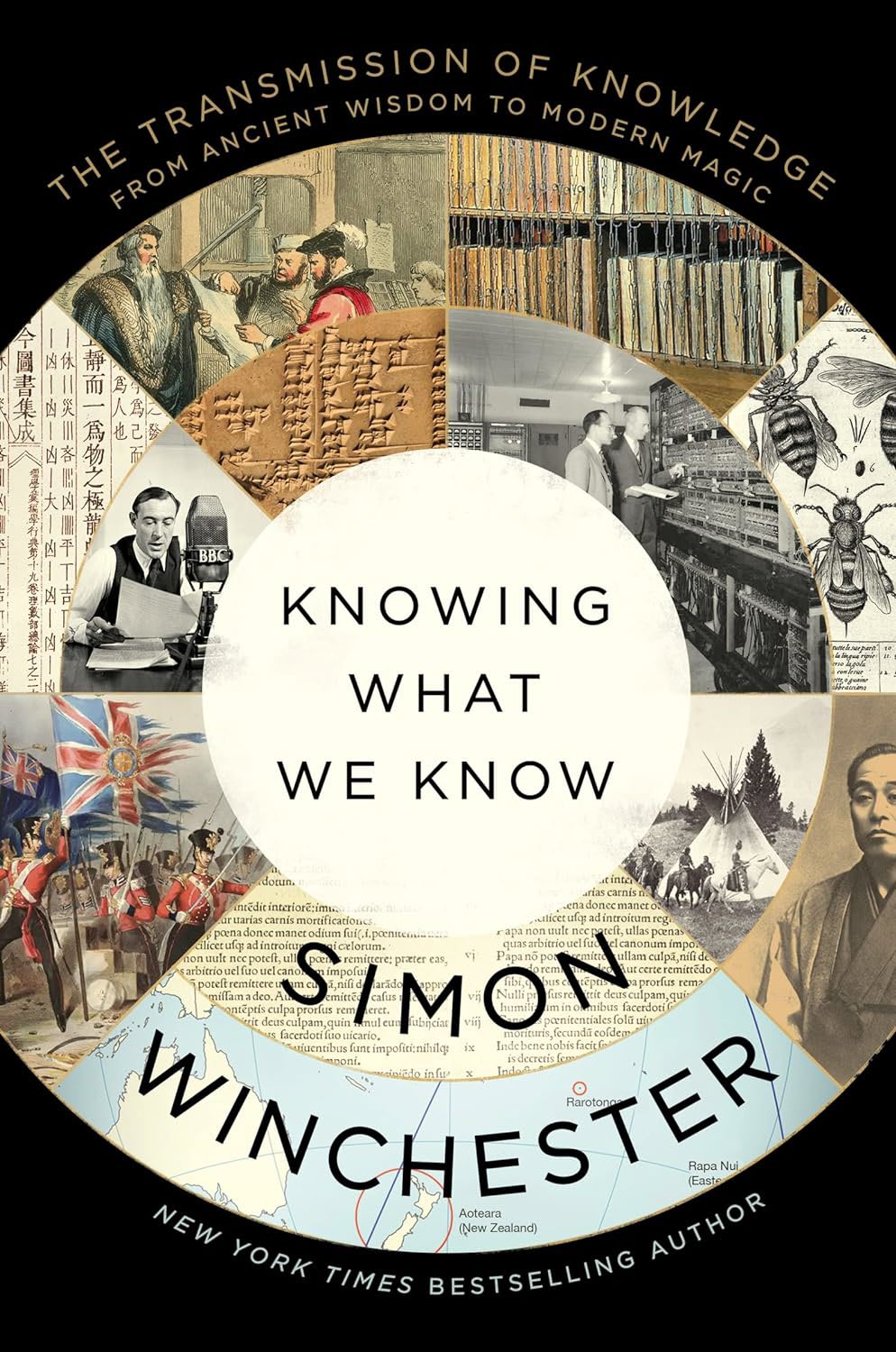
Simon Winchester is a marvel, an author of dozens of bestselling nonfiction books about everything from the Krakatoa explosion to the creation of the Oxford English Dictionary. He combines deep research with digressions, anecdotes, and odd asides.
Knowing What We Know: The Transmission of Knowledge From Ancient Wisdom to Modern Magic is a sweeping exploration of how humanity has shared information since the beginning of history. There are stories about cave paintings, ancient scrolls, the Library of Alexandria, the invention of schools, the printing press, and how the Encyclopedia Britannica became a middle-class status symbol in American homes.
The stories about Google and Wikipedia are fascinating but the tone of the book shifts as Winchester grapples with the consequences of technological progress. What becomes of humanity when everyone has instant access to all of human knowledge? How many people will take the opportunity to be intellectually lazy, quickly retrieving data but never engaging in the quiet thoughtfulness that turns knowledge into genuine insight? Are we risking our ability to think? What will the world be like if no one in it is wise?
The mental work required to acquire, organize, challenge, and synthesize information is itself part of what creates understanding. If AI eliminates the need to do that work, maybe we’re also eliminating part of the process that creates wisdom.
It’s similar to something that we’ve all noticed in the last few years. The internet rewards scanning, switching, and rapid attention shifts. The result is the general feeling that everyone in our society has shorter attention spans - less patience for books and movies that require sustained attention, less time spent on meditation and contemplation.
Wisdom is knowing what matters, what to doubt, and what to do about it. It emerges from habits of patience, uncertainty, reflection, and intellectual struggle. Simon Winchester doesn’t pretend to have answers but he is clearly troubled by the question: what becomes of humanity if those habits are no longer required?
AI Cognitive Atrophy and other scary words
If you don’t use the muscle in your head that does deep critical thinking, it can atrophy from lack of use. That’s not just an awkward metaphor, it’s a real phenomenon that researchers are getting alarmed about. Nicholas Carr sounded a warning about cognitive atrophy in his book The Shallows: What the Internet is Doing to Our Brains - and that was released in 2020, before AI started to accelerate the process.
Psychology Today published an article a few weeks ago pointing out another level to that problem: adults who offload thinking to AI can lose the mental capacity they built, but children may never build it at all. The author spots a difference in one study between participants over 46 and those between 17-25 and says:
“The most likely explanation for this is not generational preference but biological development. The older group probably offloaded tasks they already knew how to perform. The younger group offloaded task they never learned how to perform. These neural pathways for source evaluation and constructing arguments were never formed. You can’t atrophy a muscle that was never built.”
It’s called cognitive foreclosure, “the structural prevention of a mental capacity from forming. It happens when a child hands a cognitive task to a machine during the years in which she would otherwise have built the capacity to do it herself. The harm is that the capability never develops.”
Humans have always learned and developed wisdom by dealing with ambiguity and doubt and developing skills by working through problems themselves. AI algorithms take away any need to struggle – and strip away the process that develops depth, moral reasoning, and long-term reflection.
Last month the mathematical community was rocked by AI solutions to long-standing theoretical problems. Fierce arguments are raging now about whether the AI answers have advanced the field – or set it back by making it unnecessary for mathematicians to learn their craft with deep critical thinking.
We’ll talk about that next week. For now, be curious and use AI to satisfy that curiosity. But keep thinking after the answer arrives. That’s where your growth happens.