
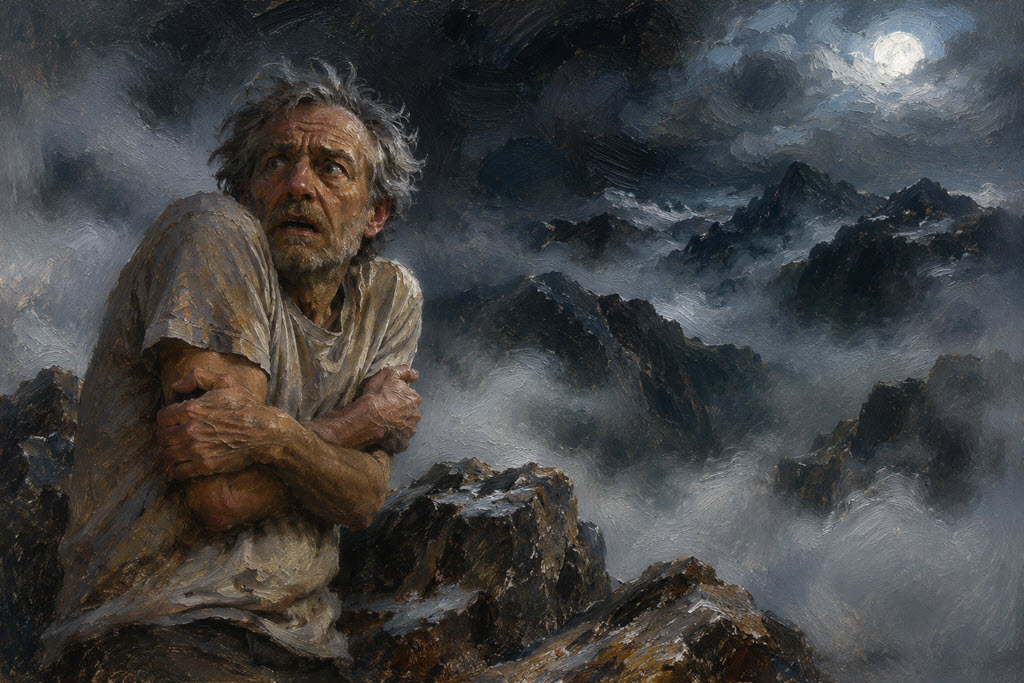
I want to tell you a story about theoretical math.
Don’t you dare click that Delete button! Haven’t I earned your trust yet? G’wan, stick with me, this is a good story about AI and how it’s affecting people in the real world, and it’s got an unexpected twist in a few paragraphs, and then another one further on that will make you really mad at OpenAI, and that’s always fun, right?
Last week’s article was about the possibility that having access to instant answers actually interferes with the processes that help people understand the world and become wise. Today we’re going to look at a very specific example of what that means, happening right now in the math community.
Don’t worry, I’m not going to describe any of the math. I don’t understand it any more than you do. Theoretical math is a blend of art and science, shared by a small and tight-knit group of professors and practitioners whose work takes them to other realms, unmapped immensities that might never exist, drawn by beauty and order and meaning that eventually can be revealed by pure reason. They wander in places you and I will never visit, but we can empathize with them as AI wreaks havoc on their world.
One of the world’s leading theorists published an article a few weeks ago, “Care for a little more AI?” Hugo Duminil-Copin is a mathematician and 2022 Fields Medalist, the equivalent of the Nobel Prize for mathematics. In his essay, he describes a theoretical problem he has been unable to solve after many years of effort. Let’s call it the “percolation problem” and that is all you need to know about that.
He makes a profound point: the unsolved problem is valuable partly because it is unsolved. For Duminil-Copin, working on the percolation problem for decades has been tremendously productive; it has led him to collaborators, techniques, and “dozens of ideas” that led to other discoveries. And his point is that the same thing is true about many of the unsolved problems that theoretical mathematicians study and obsess about. “A mathematical question is much more than a theorem waiting to be proved; it is a source of momentum. First and foremost, it is a lighthouse in the night: it illuminates and guides mathematicians in their wanderings, both esthetic and scientific.”
Duminil-Copin was driven to write his article by the likelihood that AI will be used to solve some of math’s longstanding unsolved problems. It might be a loss, not a triumph, when a problem is completed without any human work. “When mathematicians say that the process matters more than the solution, this is not an empty statement. The richness of what emerges from repeated attempts, failures, detours, and encounters is extraordinary. . . . Understanding the mathematical world requires both personal and collective exploration. The same formal concept takes on a different shape in the mind of each mathematician, through a long and gradual process of appropriation. The ideas that live and circulate within our community are the true jewels of mathematics. . . . Let us keep on the traditions of a discipline several thousand years old, and teach how to search, doubt, experiment, fail, and restart.”
The twist
Unbeknownst to Duminil-Copin, AI had solved the percolation problem he described two days before he published his essay, completely by coincidence.
An Anthropic researcher used Claude to solve the puzzle and posted the result in a Github repository on August 28 without calling anyone’s attention to it. Duminil-Copin had no idea anything had changed when he chose it as an example for his essay published on August 30.
So the philosophical issue was framed in an almost unbearably ironic way: is the purpose of mathematics to obtain correct answers, or to produce human understanding? On the one hand, Anthropic came up with the correct answer*. On the other hand, Dumenil-Copin lamented the loss of understanding, which is best gained by human beings inventing new techniques, using them to solve seemingly unrelated problems, collaborating, teaching graduate students, until the field has learned far more than just whether the original proposition was true or false.
(*Footnote: this is a gross simplification; the work continues to determine if Claude’s answer was correct, complete, or interesting, and to identify how much it leans on earlier work by human beings. None of that changes the question of whether Claude’s contribution was helpful or destructive to the field of theoretical mathematics.)
The debate about the future of math
Theoretical mathematicians were already reeling from a series of AI solutions to longstanding problems when Duminil-Copin wrote his essay. OpenAI had published an AI analysis of an Erdos problem in May that drew attention, then Anthropic moved the bar forward on the Riemann hypothesis in early August, and you know how mathematicians get about the Riemann hypothesis, they just go nuts, heated conversations, fistfights, peer-reviewed death threats, but now all the emotion was directed at AI.
On September 8, OpenAI announced that a huge AI system had resolved the 90-year-old Navier-Stokes existence and smoothness problem, one of the seven Millennium Prize Problems. I don’t know what those words mean but it sounds like a big deal, right? It must have been important to OpenAI because it had 10,000 parallel agents working on it at an estimated cost of $22.5 million.
By the end of September, the field of theoretical mathematics was in an uproar – three problems solved by AI that no one in the field of mathematics had asked to be solved. It kind of sounds like a microcosm of the entire world in 2026, doesn’t it – an assault by AI tools that we didn’t ask for and might not want?
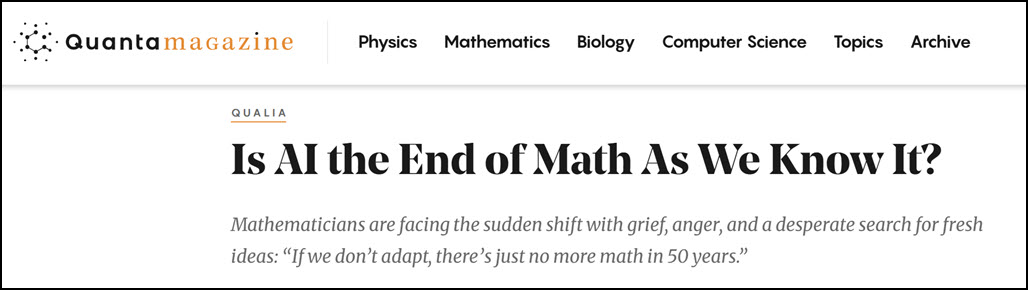
On October 5, the math editor of Quanta published an essay asking “Is AI the end of math as we know it?” She describes a talk by mathematician Ken Ono at UC Berkeley in front of students, postdocs, and professors. “‘You might be graduating into a profession that might not even exist, or that will be very different than what you expected,’ Ono told them. ‘You need to brace.’”
Twisting the knife
Then came October 6 and OpenAI tore the heart out of the entire field.
OpenAI dumped a gigantic collection of AI-generated mathematical research into public view - 377 solutions to open questions contained in 722 manuscripts, spanning much of modern mathematics, theoretical computer science and mathematical physics.
The math community normally functions through a sieve of journals and online repositories where work is tidied up, examined by peers, and verified by collaboration. OpenAI bypassed all of that, dumping its work into an online archive. The human mathematical community is now tasked with cleaning up, parsing, and verifying an industrial-scale wave of automated output. Hunting down logical gaps and symbolic mistakes is thankless, unrewarding work. Some of the papers have already been withdrawn due to errors. Others rely on reasoning patterns that are abstruse and difficult to verify.
Fields Medalist Terence Tao described OpenAI’s work as “toxic waste” and lamented the years of research by young mathematicians that had been “casually disrupted or destroyed.”
Teleporting to the top of a mountain
There’s a helpful analogy in the essay by Quanta math editor Jordana Cepelewicz.
“AI models skip to the end. At the moment, their proofs are nearly impossible to read. They elide salient details and waste pages on irrelevant concepts. They fail to demonstrate how the new work builds on or connects to other results in the mathematical literature. Mathematicians know that the proofs are true — they’re verified by a system that checks their logic) — but have no idea why. What’s missing is understanding, the currency that mathematicians trade in. If there is a journey, humans are not invited along for the ride.
"It’s as if you were teleported to the peak of a tall mountain. Surrounded by fog, you have no idea where you are, or what’s around you. You do not know how your mountain connects to others, and you have no equipment to help you explore, no way to help someone else join you. If you had climbed the mountain yourself, you would have experienced how the human body adapts to altitude and changes in oxygen levels. You might have had to invent tools to navigate, to climb steep cliffs, or to make a shelter. You might have encountered a fellow explorer, gotten lost together in a hidden valley, and found a plant that could be turned into a life-saving medicine.
“Instead you’re perched on the peak but in the dark, while the maker of the teleportation machine tells you that it can explore the wilderness better than any human.”
What happens next?
An editorial in Science has no clear answer to what happens “when AI takes away the thrill of discovery.” It ends with this anecdote: “Cornell professor Steven Strogatz told the story of a student who questioned him at a town hall on all this. ‘I want to discover things, too. I want that thrill,’ she said. ‘I don’t want my life to be in vain.’ . . . When pressed for the overall sense of morale in his field, he couldn’t muster much sunshine. ‘Most people, I think,’ he said, ‘are in grief.’”
AI’s effect on science and math is only an example of how OpenAI and Anthropic and the other AI-obsessed tech behemoths are spoiling the world for almost everyone. Mostly they show no self-awareness at all, zero, complete moral blindness. So when OpenAI took a tiny, insignificant, nearly invisible step toward recognition of their blundering a few days ago, it’s hard to get excited. I’ll give them all the credit they deserve, which is, pllfffft.
“We are announcing three new discoveries in mathematics, computer science, and physics about harmonic analysis, complexity theory, and quantum field theory. Our release process continues to evolve in response to feedback from the associated academic communities.” (Emphasis added.)
To be clear, the feedback from the academic communities is: “We hates them, sneaky little AI, wicked, tricksy, false. We wishes it would go away, far away.”
OpenAI came up with three different strategies to “convert the raw science data into scientific understanding.” The three strategies are: dump the answer; get a group of human beings to look at the answer first, then dump it; and give it to a group of human beings and let them decide what to do with it. Interestingly, they omitted the obvious fourth option, which is to shut up and let mathematicians do their work.
The statement goes on: “We welcome feedback on what works and what we can improve.”
Do they? Do they welcome feedback? Because there’s no indication they’re listening to feedback about anything else they’re doing to the world.
If you see any theoretical mathematicians, be nice to them. They’re having a hard time in the Age of AI.