
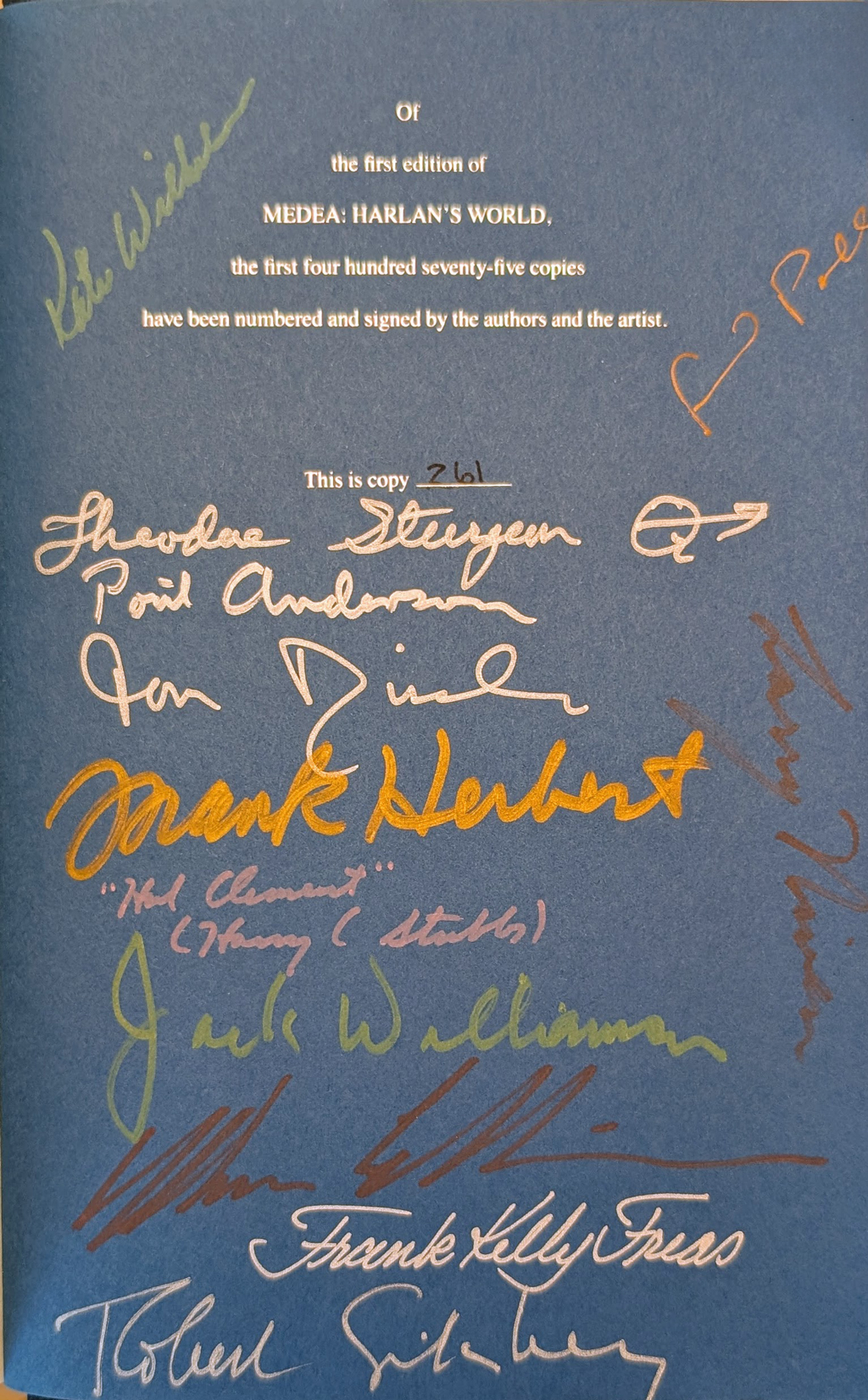
The signed limited edition of Medea: Harlan’s World has one of the greatest collections of signatures of all time. Sheets were circulated among eleven legendary authors, then bound into a deluxe edition of one of the most ambitious experiments in the history of science fiction.
Like many, many good stories, this one starts with Harlan Ellison. I’ll do what I can to introduce him in case his name is unfamiliar - how quickly our giants fade away! (Ellison was only five foot two, not quite a giant, but he had a personality the size of a weather system.) Stick around for a description of the Medea project, then we’ll pay our respects to the authors on that signature page.
Harlan Ellison
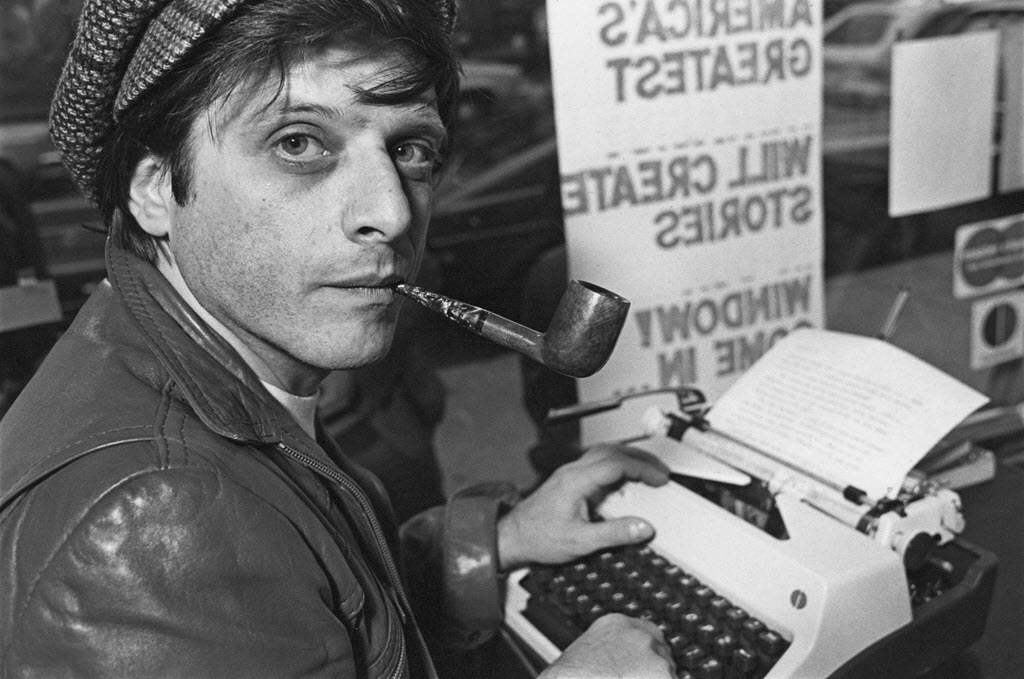
Harlan Ellison was a celebrated writer who died in 2018 and is already starting to disappear from memory in our short attention span world. His profile has been raised in the last couple of years by his literary executor, J Michael Straczynski, who has arranged for new editions of his greatest hits and best-known anthologies.
Trying to summarize Harlan Ellison’s life and impact is like mapping a lightning strike with sidewalk chalk, a likely futile attempt to describe something gloriously uncontrollable.
Harlan Ellison wrote more than 1,700 short stories and articles, at least 100 books, and dozens of screenplays and television scripts. His creative output was most explosive from the mid-1960s through the 1970s, when his cultural influence peaked and he played an outsized role in reshaping television and print. His anthologies Dangerous Visions and Again Dangerous Visions fundamentally changed and expanded the boundaries of speculative fiction. He wrote an episode of Outer Limits, Demon With A Glass Hand which is widely regarded as one of the greatest television episodes ever produced. He wrote The City On The Edge Of Forever, universally voted by fans and critics as the single greatest episode of the original Star Trek series.
Ellison garnered a staggering number of Hugo, Nebula, and Bram Stoker awards and ultimately earned the title of SFWA Grand Master for his profound influence on the evolution of science fiction, dark fantasy, and modern culture.
He was a flamboyant character in person, brilliantly witty, instinctively knowing how to hold the spotlight, one of the world’s great storytellers. I encourage you to spend an hour listening to a conversation where Ellison is so entertaining and funny that Robin Williams (!) sits back to listen to the stories pouring out (part 1, part 2). But he was also quick to outbursts over perceived injustice, uncompromising and fearless (and frequently litigious) in the face of authority.
Watching Ellison write was like watching a jazz musician improvise a solo. He wrote his stories on manual Remington typewriters in fully formed, hyper-articulate sentences, at speeds of 90 to 100 words per minute. There was no hesitation, no staring blankly at the ceiling, and very little crossing out. He would occasionally visit a bookstore, take a prompt from a bystander, and sit in the bookstore window producing a finished story by the end of the day, taping each page to the wall for customers to read as they came out of the typewriter. Although his works were most often categorized as science fiction, Ellison’s stories never fit into easy categories.
His writing style has a few too many flourishes for today’s streamlined aesthetic. Modern tastes lean toward minimalist prose; Ellison wrote like every sentence was trying to kick the door off its hinges. Since his death there has been more focus on his anger and manic episodes, which diminish the legend because that’s what we do with legends today. He probably had undiagnosed bipolar disorder.
I don’t care about the flaws. I like the legend. And the stories, ah, the glorious stories. No one wrote like Harlan Ellison.
Ten Tuesdays Down A Rabbit Hole
In April 1975, UCLA Extension asked Harlan Ellison to teach a 10-week science fiction writing course. Ellison decided that instead of a traditional lecture series, he would stage a live, interactive experiment in world-building before a packed theater audience. He called the course "10 Tuesdays Down a Rabbit Hole."
Before the course started, Ellison brought together a brain trust of hard science fiction masters to design a plausible alien ecosystem from scratch. Hal Clement, Poul Anderson, Larry Niven, and Frederik Pohl collaborated to create the science behind Medea - a tidally locked moon orbiting a red dwarf star with massive oceanic tides, gas-bag flora and fauna that could navigate wild wind currents, and sentient life. The raw scientific data was packaged into a dense booklet that was passed out to the UCLA students.
On the evening of April 15, 1975, Ellison walked out onto the stage of a packed UCLA auditorium alongside four legendary literary minds: Frank Herbert, Theodore Sturgeon, Robert Silverberg, and Thomas M. Disch. Sitting in front of a live audience of students, Ellison pulled out the Medea science booklet and gave them a challenge: Right here, right now, in front of these people, tell me what stories you are going to write based on this world.
What followed was a brilliant, chaotic, and occasionally combative panel discussion. The authors argued about the constraints, misunderstood the biology Larry Niven had laid out, corrected each other on the physics, and actively pitched narrative hooks back and forth. The students joined in, asking questions and calling out logical flaws.
At the end of the evening Ellison challenged the writers to go home and write original stories set strictly within the parameters of this newly minted world.
It took ten years for Ellison to pull together the book published as Medea: Harlan’s World. The book includes the hard-science background, a transcript of the chaotic live seminar, essays with reflections and clarifications, and eleven stories set on the fictional world.
There have been other collaborations between well-known authors on shared worlds since then - Robert Lynn Asprin’s sprawling fantasy Thieves’ World, George R. R. Martin’s series Wild Cards, and Neal Stephenson’s multi-author project The Mongoliad, for example.
Harlan Ellison’s work on Medea was a unique academic performance piece and inspired those later projects.
The authors
Eleven titans of science fiction contributed to the Medea project:
- Harlan Ellison
- Jack Williamson
- Poul Anderson
- Larry Niven
- Robert Silverberg
- Frederik Pohl
- Frank Herbert
- Thomas M. Disch
- Kate Wilhelm
- Hal Clement
- Theodore Sturgeon
These are names to conjure with. Nine of them won Hugo awards, all were honored extensively by the SF community and the Science Fiction Hall of Fame. The Damon Knight Memorial Grand Master Award is the highest lifetime achievement honor bestowed by the Science Fiction and Fantasy Writers Association. It is extraordinary that seven of the Medea authors went on to be named SFWA Grand Masters.
Many of them have now passed away. Their work lives on. Each of them deserves credit for masterful mindbending work during their careers. I’ll only single out one because his star is in ascendance now: Frank Herbert, author of Dune, the best-selling and most influential science fiction novel of all time, maybe you’ve heard of it?
Medea: Harlan’s World
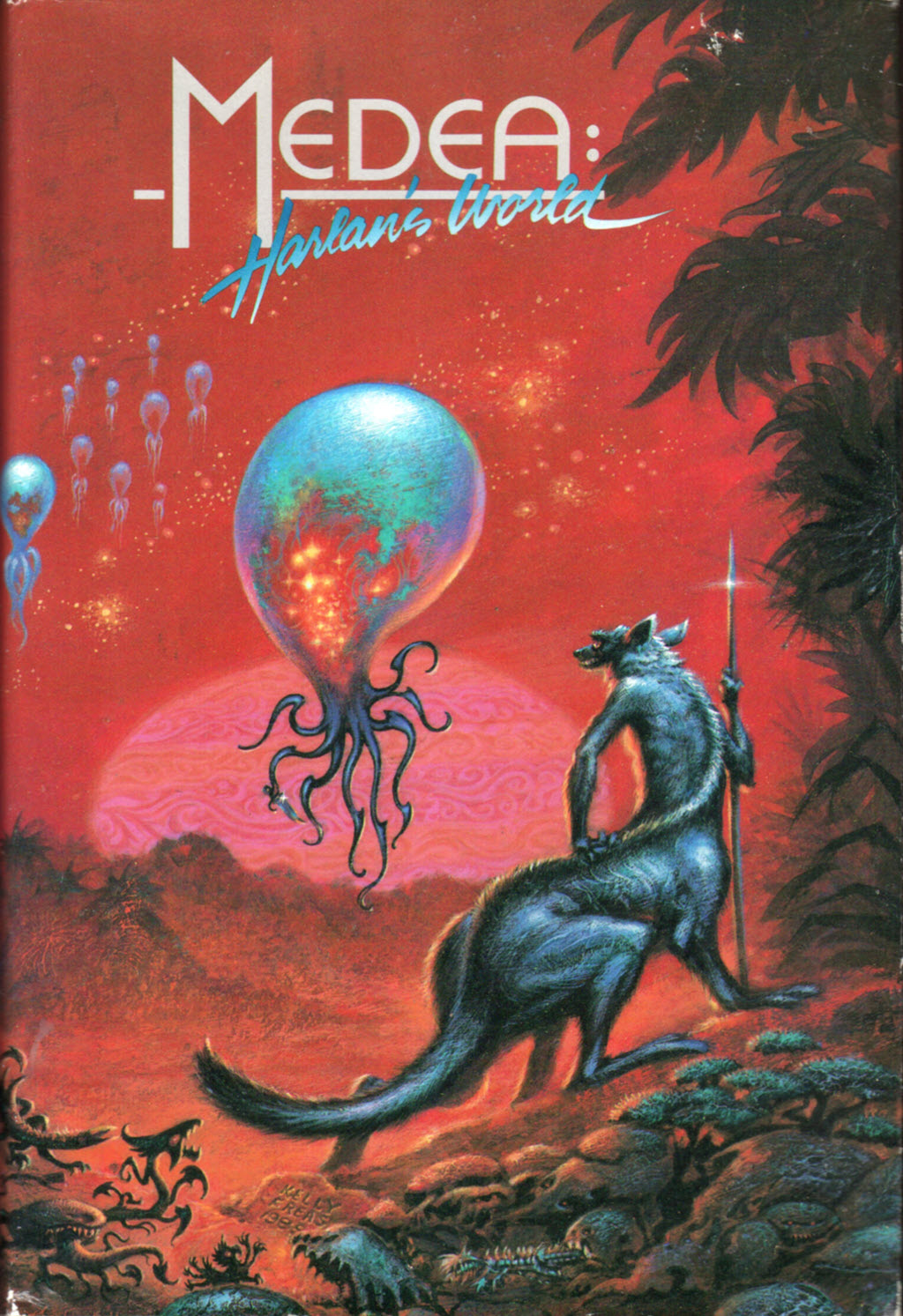
For some reason multi-signed anthologies aren’t particularly interesting to many collectors. There have been many inventive projects in the genres - SF, fantasy, mystery - where multiple authors sign the same page, but collectors get more excited by a book signed by a single author. (Fun fact: literary authors are solo performers; there has almost never been an authorized signed limited literary anthology.)
I love multi-signed anthologies. Someday I’ll tell you about some of the other fun signature sheets I’ve got in my collection, crowded with the names of great authors.
Medea stands out.
Alex Berman of Phantasia Press took on the job of coordinating the physical sheets to be passed around, signed, and returned by eleven busy authors around the country without damaging or losing them. They were bound in at the rear of 475 numbered copies of a special edition of Medea: Harlan’s World.
Several of the contributors passed away shortly after the book’s release - most notably Theodore Sturgeon who died as the book was being finalized in May 1985, and Frank Herbert, who passed away in early 1986. Most of them are now gone.
Medea: Harlan’s World is one of the very last artifacts to capture this generation of Golden Age SF titans. It’s a tangible connection to my adolescence, all those late nights reading classic SF. Take my word for it, that is one great signature page!