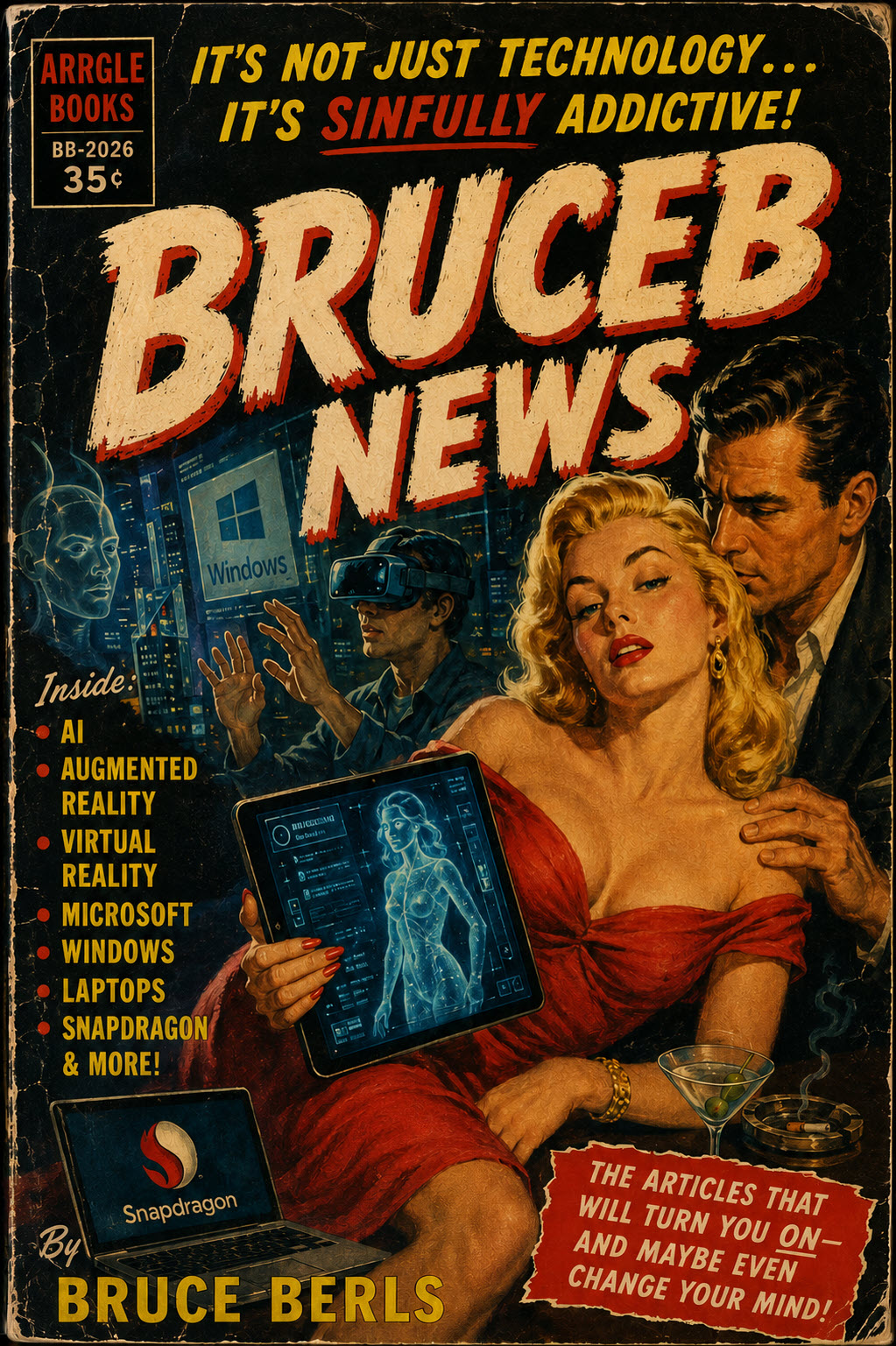
For a brief period in the 1940s and 1950s, mass market paperback books had covers with sultry women, shadowy detectives, and thrilling action, sold for a quarter at newsstands and drug stores across the country.
Let me tell you the story about how lurid pulp covers democratized literacy, sparked a federal moral panic, and permanently altered the course of modern book design.
Democratizing literacy
Until the 1940s hardcover books were expensive luxuries sold in high-end bookstores.
Pulp magazines became popular in the 1930s - cheap mass-produced fiction printed on low quality paper and sold for a dime, affordable escapism during the Depression. The paperback industry followed that course when it launched in 1939, selling books for a quarter in the same places that pulp magazines were sold - wire spinner racks in drugstores, candy shops, newsstands, and train stations.
Impulse sales, that was the ticket! Publishers only had a second or two to catch the eye of a casual passerby, so the books on the newsstands featured lurid artwork and sensational taglines promising glamorous women, dangerous men, guns, fists, embraces, torn clothing, whiskey bottles, neon signs, gangsters in fedoras, motorcycles, sex, sadism, and terror.
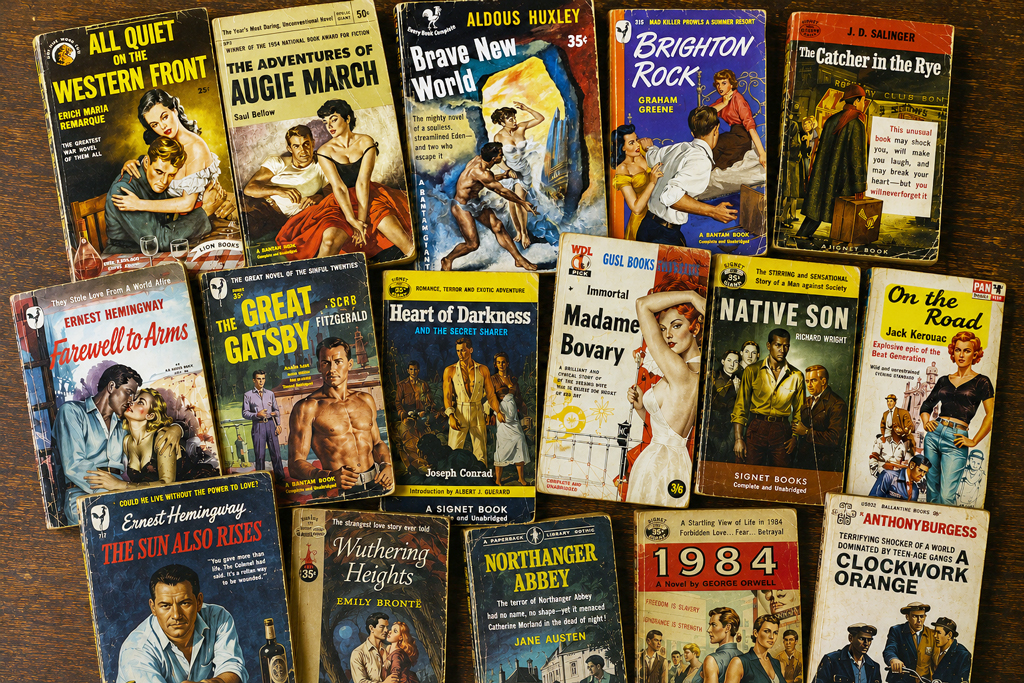
There was no shortage of low-quality paperbacks with pulp covers, but publishers also packaged William Faulkner, Joseph Conrad, and Saul Bellow to look like detective stories or romance potboilers. (I only own a couple of the books pictured above; the picture was assembled by AI but the covers are the real books sold in the 1940s-1960s.) The Great Gatsby turns into a violent crime thriller. The Catcher in the Rye becomes a gritty urban potboiler. You can’t tell a book by its cover, but you can sell one that way.
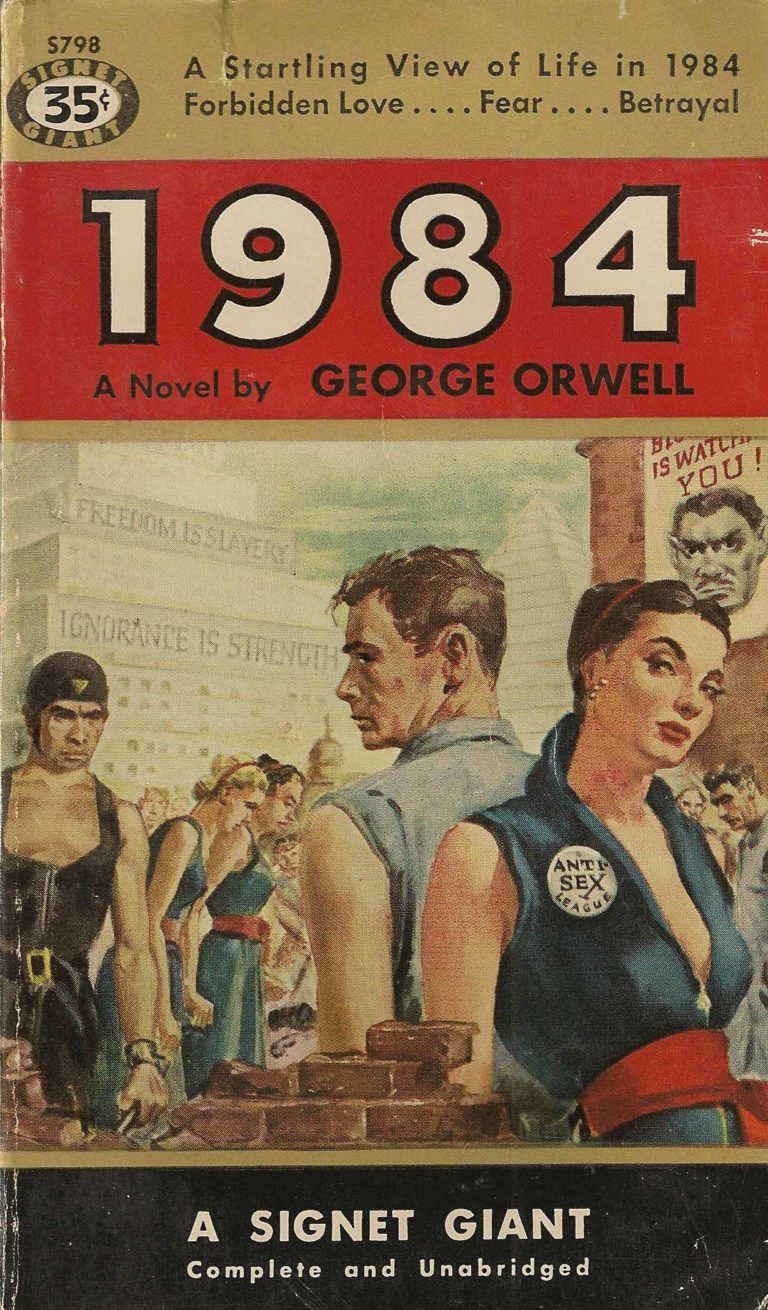
George Orwell’s 1984 was given a distinctly S&M vibe. In The New Yorker magazine, Louis Menand describes the cover this way:
“The cover of the 1950 Signet reprint… features a surprisingly toned Winston Smith, in a sleeveless top that shows off his triceps nicely, sneaking a glance at a slinky Julia, in lipstick and mascara, who wears an Anti-Sex League button pinned to a blouse with a neckline that plunges to her tightly sashed midriff. The artist has rendered O’Brien, Winston’s nemesis, as a sort of sadistic swimming instructor—a menacing dude clad in a black skullcap and halter-top outfit cut daringly across the pecs, and clutching what it is hard not to assume is a whip.”
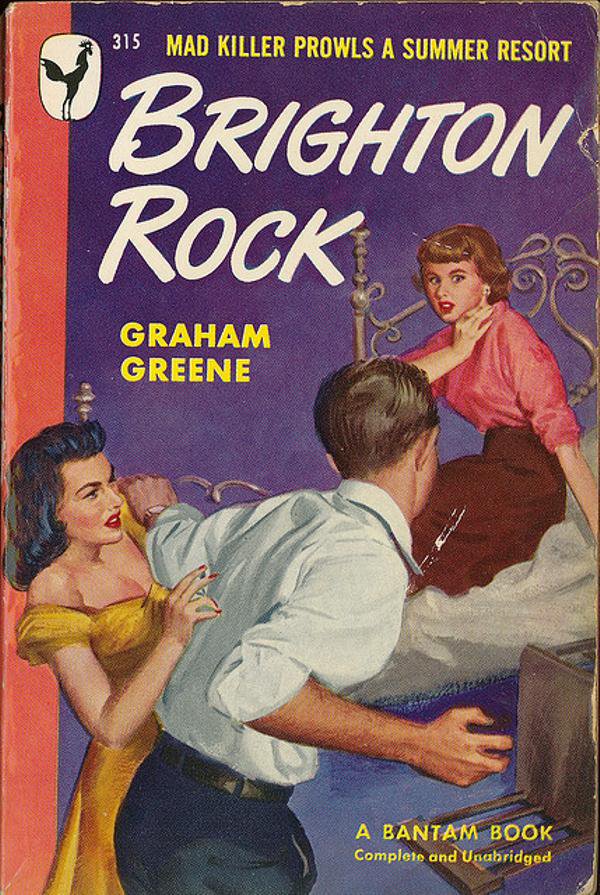
Graham Greene intended his dark Catholic crime novel Brighton Rock to be remembered as one of his serious literary efforts, but the pulp cover, with its tag line “MAD KILLER PROWLS A SUMMER RESORT” promises a lurid melodrama, glamorous women, and perhaps a jealous love triangle.
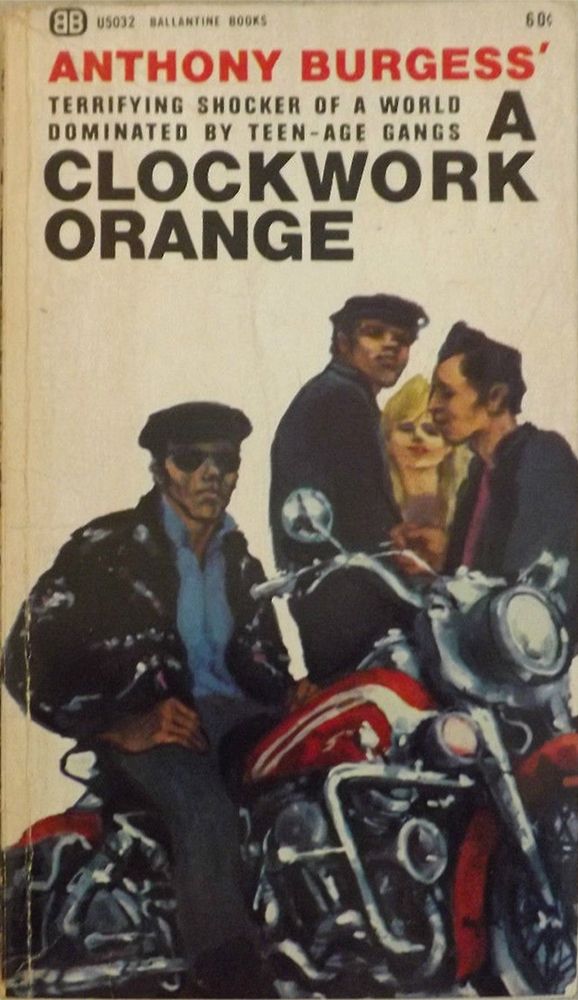
A Clockwork Orange is a literary novel about free will, morality, and state power. There are no leather jackets in it. There are no motorcycles.
Today we laugh at the mismatch between the salacious art and what we think of as “fine literature.” But there are some extra dimensions to think about.
The real reason these books became classics is that they’re great stories. Try reading 1984 or Brighton Rock for enjoyment instead of approaching them as homework assignments. We’ve forgotten that they’re great reads. The pulp paperback publishers proved mass audiences would read Literature with a capital L if it was affordable and had a cool cover. It was an effective way to democratize culture.
Publishers distributed pulp paperbacks to the military and sold them in truck stops and diners to long-haul truckers and bus passengers. Factory workers would read paperbacks during smoke breaks. A generation of youngsters with limited formal education developed reading habits thanks to those impulse buys.
And the paperbacks exposed authors like Richard Wright and stories of Jim Crow and racial inequality to the masses.
I would gladly support the reappearance of femmes fatales and rain-soaked streets on the shelves of airport bookstores if it got people reading Hemingway and Fitzgerald. It would never work, though. Roaming gangs of prudes would spring up to complain, just as they did in 1952.
Federal moral panic
In the aftermath of World War II, many people were hungering for stability and a return to normality, as “normal” is defined by heterosexual white people – the high priests of permissible ideas who still today believe they should be able to censor books about race and LGBTQ choices and history.
At the end of the 1940s, the paperback industry was putting visible challenges to family-centric monogamy on every street corner. The guardians of public decency clutched their pearlsand reached for their smelling salts.
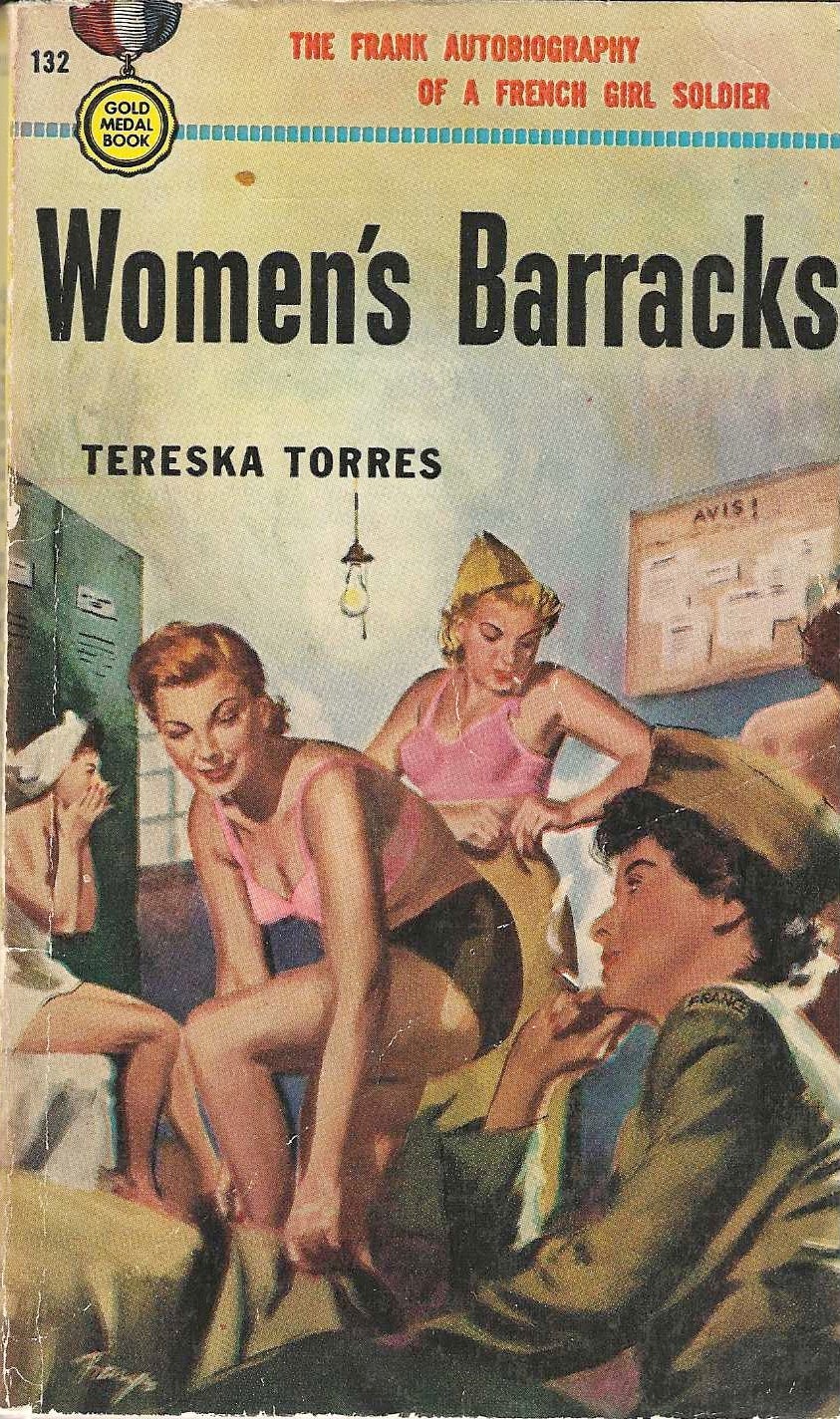
Along came Women’s Barracks, a pulp paperback published by Gold Medal Books in 1950. Maybe it was a novel, maybe it was a true story about women in the French Army; in either case, it was clear from the cover art that the book contained lesbian characters and possibly even a lesbian romantic story line.
Something about Women’s Barracks made it a bestseller. It shot to the top of the charts. Were there bookselling charts in 1950? That might be a metaphor. Women’s Barracks sold a million copies in the next year or so.
Clearly what was needed was Congressional hearings.
The beginning of the 1950s was a bizarre paranoid time in Washington D.C. Congressional committees were engaged in horrible persecutions that hurt people. Senator Joseph McCarthy started his smear campaign against imaginary communists in hearings in 1950, beginning a reign of terror that lasted four years. A Senate committee launched a witch hunt against gay and lesbian government workers based on a conspiracy theory that they might be vulnerable to Soviet blackmail, leading to the loss of jobs for thousands of civil servants and military personnel. The House Un-American Activities Committee forced Hollywood writers, directors and actors to identify suspected communists, laying the groundwork for a blacklist that destroyed hundreds of careers.
US House Representative Ezekiel Gathings wanted to throw more witches onto the Washington pyres but all the good targets were taken, so he formed the House Select Committee on Current Pornographic Materials to deal with the threat of (drum roll) pulp paperbacks. At the hearings in 1952, Women’s Barracks was the poster child of moral decay, proving that paperback books “promoted moral degeneracy.”
At the hearings the president of Gold Medal Books read a letter from a literary expert comparing Women’s Barracks with Plato, Homer, Sappho, Shakespeare, and Marlowe. Committee members were scandalized by the audacity and shamelessness.
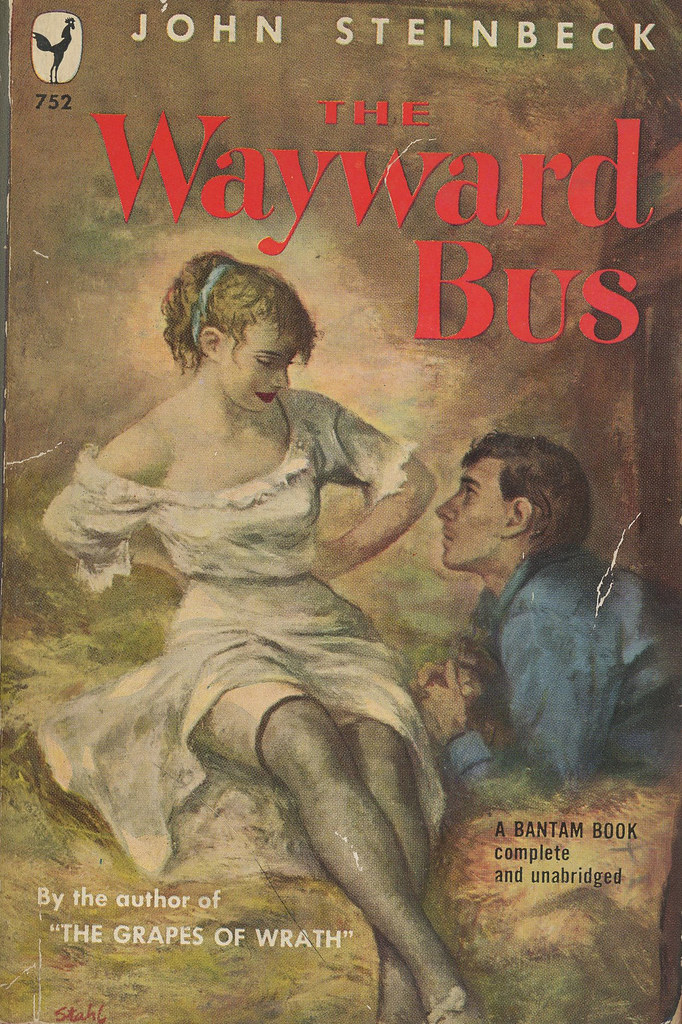
It wasn’t just the lesbian stories. The Gathings Committee was also aghast that pulp covers were being used to sell Serious Literature. The paperback edition of John Steinbeck’s novel The Wayward Bus was used to prove that publishers were weaponizing sex appeal - a cover with a voluptuous woman, promotional blurbs about “wild passion,” and passages read aloud during the hearings involving (gasp!) sexual tension. Committee members were shocked, shocked, that teenagers could buy George Orwell and Graham Greene novels for 25 cents at newsstands! Publishers drily pointed out that authors being singled out by the panel like John Steinbeck and William Faulkner had won Nobel Prizes and Pulitzer Prizes.
The committee embarrassed itself thoroughly with its puritanical farce. Journalists made fun of the House members for the long hours spent arguing over whether a pulp cover of a woman in a slip constituted a national security threat or a public health hazard. The minority dissent compared the panel’s zeal to medieval book burners. Women’s Barracks went into a second printing and sold millions more copies. Sales of books targeted in the hearings skyrocketed - an early demonstration of the Streisand effect.
The evolution of modern book design
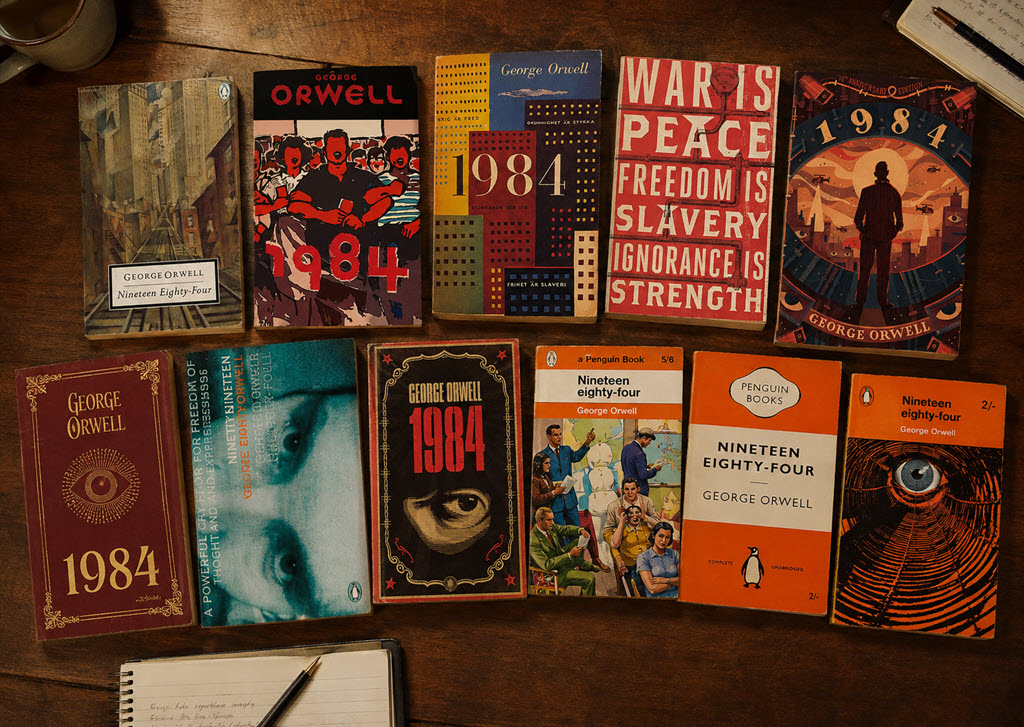
The pushback against trashy pulp covers had an impact. Styles changed and publishers made compromises to avoid bans. Mass-market paperback editions of serious literary works gradually toned down their covers. The door was opened for abstract modernism, bold typography, pop art collages, and covers that dropped all art and contained text only. 1984 has had many covers since 1950 but none of them since that first paperback have featured bulging muscles and S&M overtones.
Pulps shaped popular culture and brought classics to people who might otherwise have read comics or scandal magazines. I started reading in the 1960s and I fondly remember many of those covers. From our vantage point in 2026 there is such wonderful ambiguity in this line from a 1951 advertisement by publisher New American Library: “There is real hope for a culture that makes it as easy to buy a book as it does a pack of cigarettes.”